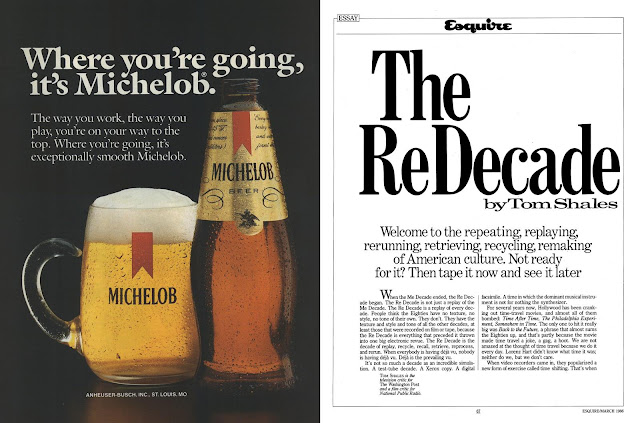
THE RE DECADE (Esquire, March 1986) (full article here)
by Tom Shales
When the Me Decade ended, the Re Decade began. The Re Decade is not just a replay of the Me Decade. The Re Decade is a replay of every decade. People think the Eighties have no texture, no style, no tone of their own. They don’t. They have the texture and style and tone of all the other decades, at least those that were recorded on film or tape, because the Re Decade is everything that preceded it thrown into one big electronic revue. The Re Decade is the decade of replay, recycle, recall, retrieve, reprocess, and rerun. When everybody is having déjà vu, nobody is having déjà vu. Déjà is the prevailing vu....
It is eerie, this preemptive resemblance of Shale's opening paragraph - the Re Decade riffs - to the intro to Retromania. Now my intro actually recycles some of my own writing - a piece bemoaning retro ism and reissue overload written for The Guardian in 1990 , uses similar riffs. But I know I never read the Esquire piece at the time - it wasn't a magazine I'd ever have looked at, especially not the US version of it.
Back to Shales's argument...
It’s not so much a decade as an incredible simulation. A test-tube decade. A Xerox copy. A digital facsimile. A time in which the dominant musical instrument is not for nothing the synthesizer. For several years now, Hollywood has been crank-ing out time-travel movies, and almost all of them bombed: Time After Time, The Philadelphia Experiment, Somewhere in Time. The only one to hit it really big was Back to the Future, a phrase that almost sums the Eighties up, and that’s partly because the movie made time travel a joke, a gag, a hoot. We are not amazed at the thought of time travel because we do it every day. Lorenz Hart didn’t know what time it was; neither do we, but we don’t care.
When video recorders came in, they popularized a new form of exercise called time shifting. That’s when you pick up a program meant to air at 8:00 p. M. and play it back at 11:30. David Letterman once did his Late Night show as a morning show for all the people who Betamax his program the night before and play it back the morning after. David Letterman understands television. He understands replay. He keeps telling his audience his show has been on since “the late Fifties. ” Prove it hasn’t.
We are all time shifters now. Or time shiftees. Time is for shifting. In an electronic society, where every day is a Broadcast Day, time takes on a new relativity, relatively speaking. We’re afloat in an illusory symbol world; we’re not lost out here in the stars but out here in the electrons. Television, where it’s always now, is almost always some other time as well. What does it do to us? You might say it gives us jet lag all the time. Or at least time lag all the time. Look, I’m no psychiatrist; then again, neither are a lot of psychiatrists. I’m no good at being noble, but it doesn’t take much to see that the problems of three little people don’t amount to a hill of beans in this crazy world. With time in a constant state of shift, our lives increasingly vicarious, our contact with other humans growing ever more remote, we’re dislocated, disoriented, disengaged. We need new bearings for a new world.
Yes, it’s long been axiomatic that the past is prologue and my how time flies and yesterday all our troubles seemed so far away. And no less a sage than Joan Crawford said in no more a movie than Autumn Leaves that “the present is made up of bits of the past.” Today she would have said bytes. But never before have people, or a people, had nearly unlimited access to what has gone before, been able to call it up and play it back and relive it again and again. We are bombarded with messages as We are bombarded with cosmic rays, but the messages we can see and hear, and many of them were originally sent long ago or not so long ago. Or not so long ago, but from some other time. Since you never know what you’ll get or where you’ll be, when and where begin not to matter.
Television is the national time machine. Television is the national playback machine. Hey baby, if I may call you baby, it’s the Eighties; layback and playback. Click, and it’s 1971 and skirts are up to here; click, and it’s 1969 and Johnny Carson’s hair is still dark; click, and it’s 1971 and Edith Bunker is going through menopause; click, and it’s 1955 and Ralph Kramden is proposing that his wife Alice be the first human on the moon; click, and it’s 1985, but the cast and crew of Moonlighting have conspired to give the show the black-and-white look it would have had in 1945. And we’re lost out here in the stars. Or the electrons.
In the Re Decade, it is justifiable to look about the video terrain and its jumble of warring factions from other moments near and far and conclude: There is no here here. There was no then then. There is no now now. Just video voideo. Television land. Cable has made this even worse, or better, depending on how you look at it. Everywhere one runs into some other time and some other space, two things television has always violated—with facility if not alacrity—only now, the violation is accelerated. With cable, there is an explosion of outlets for program sources, but since not enough new programming can possibly be produced, anything ever made for television becomes encore material. This, after all, is the age of the ancillary market. Everything is coming back, and everything being made now is designed with comebackability built in. Lome Michaels, himself recently recycled as producer of Saturday Night Live, says, “It used to be that television was sort of biodegradable. You did it and left it behind. Now we live in a time where nothing is ever going to go away again. ”
This doesn’t necessarily mean that topicality in programming, including topical humor, will disappear, because according to the new rules of media consumption, yesterday’s topicality might be today’s nostalgia. However, it is worth noting that while the best part of The Tonight Show is Johnny Carson’s topical monologue on the day’s and week’s events, that’s not the part that has been packaged and syndicated as Carson’s Comedy Classics. The A material was deemed dated and the B material gets immortality. Still, it’s common on a Monday night to tune in NBC and hear Carson joking about Billy Beer or James Watt on The Best of Carson.
On cable, it’s almost always some other time. It’s 1977 and time for James at 15. It’s 1980 and time for The Associates. It’s 1967 and time for Dragnet, a recycle even then. If you’re really lucky, it’s 1950 and time for Time for Beanie. On a good night, or a bad night, you can get a different year from every channel. Sometimes the later it gets at night, the earlier it gets in television history. Russell Baker, in a rare column about television, once observed that after midnight, the movies all get better and the commercials worse. Old television flourishes after midnight, too. Jack Benny is back from the dead in the dead of night, and Gracie Allen is lobbing nifties past George Bums again, and niece Kelly is complicating life for John Forsythe, who is not Blake Carrington but instead a black-haired Bachelor Father. The family car has fins.
People still think of television as a device of instantaneous communication, but chances are, when you turn it on you are not going to get anything very instantaneous, except for the instantaneous playback of a film or tape recorded hours, weeks, or years earlier. You are going to see yesterday, or the day before that, or a night in 1974 when Christie Love was chasing a fake crook across a prop roof in a once-forgotten, now-remembered, soon-to-be-forgotten-again cop show. Get Christie Love! lasted only two seasons on ABC and should not, by the old laws of television economics, be back. But it’s playing on a cable network that apparently hasn’t got anything better to play. Watching cable TV is like wandering through the networks’ burial ground. Every night is the Night of the Living Dead.
Television and the newer associated technologies bring the world into the living room as the clichés of the Forties and Fifties promised they would, but that world turns out to be a matrix of many worlds that have gone before. When you turn on TV now, you get the war of the worlds, meaning not that you get Gene Barry chasing Martians out of farmhouse attics. It’s a war you don’t have to worry about fighting. You just sit there and let it wash over you. You sail through time zones willy-nilly. You wander among not just the looks, the fashions, the fads, the personalities and events of other times, but also the sensibilities. Only the commercials are almost always new, and some of those try to look old, or reprocess old film footage into new spiels.
Television is the culture, of course. What it does and what it fixates on affects everything else. Values are being reordered, like the value of timeliness, which is itself becoming passé. The Re Decade makes a mockery of a lot of things. What it may most make a mockery of is this phrase: “The fullness of time.” It feels more like the emptiness of time now.
Henceforth, decades will be like airports. You won’t know which one you’re in. They’ll all look like the others. Zeitgeist goes Zen. You don’t like 1986? Fine. Punch up another year. The Re Decade is a byproduct of the communications revolution—cable and satellites and computers and home video. Ours is becoming a totally call-up culture. You call up the year, the month, maybe even the day and time you want; selection is hardly infinite, but it’s getting wider all the time. And people spend more and more time with television; that’s documented.
Babies bom now can have their whole lives electronically taped on portable 8 mm video equipment. Someday they may be able to call up any moment of those lives as well as calling up any moment of Gary Coleman’s life and a great deal—indeed, more than is decent—of Lome Greene’s life. If you turn on cable TV, you discover that Bobby Van, who died in 1980, is very much—well, largely, quite a bit, sort of, and rather—alive, and hosting a game show called Make Me Laugh (it might better have been called, from Van’s point of view, Make Me Breathe). The late Mr. Van is as crisp and bouncy on videotape as is Merv Griffin, who was recorded only a week ago, or David Letterman, who was recorded seven hours ago, or the weatherman, who is actually, just as he appears to be, alive. Peter Lawford died, but it wasn’t long before he was resurrected on a cable TV rerun of The Gong Show. What is going to happen when we can make Grandpa and Grandma, and Mom and Dad, and almost anybody else live again with the plop of a cassette into a tape machine and the press of a few buttons? Krapp’s last tape was nothing by comparison.
Video recording is different from movies and radio. We could possess a thirty-yearold audio recording of Grandpa, yes, that would evoke him when we listened to it, but the experience would be incomplete and we’d have to complete the rest of it in the mind. Movie imagery we associate with fantasy; there’s another layer in there between us and the subject that the camera photographed. With video, you get everything but the smell of Grandpa’s cigar and, yes, the touch of his hand (a large part of the mind can go to sleep, or be put on hold). It would be potentially disorienting, even to a frightening extreme, except that we’re all getting used to larger and larger parts of our lives being illusory. Ah, it’s that old media-theory talk about the line between fantasy and reality. In fact the talk is passé, because the blurring and the overlapping are things everyone is taking for granted now. We don’t care that Ronald Reagan may not be the man he seems. We only care that what he seems pleases us and that he continues seeming it. With Ronald Reagan we get a President made up of reprocessed bits and pieces of old movie heroes. Ronald Reagan, Ronald Rerun, Ronald Re-Again; it’s so neat, it hurts. We have our first re-President. David Steinberg, the comedian, has said that when he sees the commercial with the actor who says, “I’m not a doctor, but I play one on television, ” he thinks of Reagan: “I’m not a President, but I play one on television. ”
We like the old-fashioned Reagan image so much (he really seems closer to Ward Bond on Wagon Train than to Ronald Reagan on Death Valley Days) that should, God forbid, anything happen to the President, it would be a national shock to switch over to someone like George Bush. Bush appears to exist first for the real world, second for the media world. Won’t do. Out of whack. The rules of succession should be amended so that David Hartman, the logical successor, could step into the Oval Office if necessary....
Another interesting thing about this Shale article is how little popular music figures in it. Shales's reference points almost entirely stem from television, as would be expected given that he was the TV critic for The Washington Post. When he does mention pop - as in this next bit - it's things like Madonna's Marilyn Monroe-isms in "Material Girl" and, bizarrely, the Manhattan Transfer. Later on he mentions synthesisers as intrinsically postmodern, in a section about collage as the art form of the '80s - apparently unaware that this term would fit much better the sampler.
Nonetheless, through TV and the entertainment zone he's most familiar with, Shales perceptions about a coming atemporality and a recursive uncanniness to the way popular culture will operate going forward, are pretty prescient. It's an impressionistic and intuitive prescience, led by feelings and sensations - and by his deep immersion in the medium.
Back to Shales...
“What were the Eighties like, Daddy?” “Well, here, take a look at this videotape of MTV.” MTV is a twenty-four-hour-a-day reprocessing center. The people who make videos are the cutting-edge visual literates of our time. They may not have read everything but they have seen everything. They know how to make Madonna in Material Girl look like Marilyn Monroe doing “Diamonds Are a Girl’s Best Friend” in Gentlemen Prefer Blondes, and they know that the audience will know what the reference is. Art directors and cinematographers and costumers can now whip up almost any period on cue, so long as it’s from the days of movies or TV. If they want to make something look like the French Revolution, their resource would be a Hollywood movie about the French Revolution. So that the MGM version would become equivalent to textbook truth. But mostly they re-create the looks of the Thirties, Forties, Fifties, Sixties, and Seventies. “Weird Al” Yankovic and the Manhattan Transfer have both, separately of course, projected themselves into the Ricardo living room for music videos that used an I Love Lucy milieu. Queen projected itself into Fritz Lang’s movie Metropolis for their Radio Gaga. Elton John made a video in which he sashayed through old movies, and Phil Collins made a video in which, get this, he sashayed through old videos (you can have a history in about a week now and become a tradition in about a month). When color films of World War II taken by the great director George Stevens were uncovered last year, they looked fake, because baby-boomers think of the war as having been fought in black and white (they’ll always have Paris as Bogie and Bergman had it; in fact they can have it whenever they put the cassette into the VCR and play it). Blue-jeans ads attempt to replicate the adventure-movie milieu of the Indiana Jones pictures, which are themselves replications of the movies that little Stevie Spielberg saw as a kid. Hey, did this guy go to too many movies, or what? Amazing Stories episodes are really twenty-two-minute movie trailers— coming attractions for movies that have already come. And gone. And will come again.
One question now is whether the Eighties have a look that anybody will ever try to re-create...
Cue laughter from the present.
(Never mind a spiritual essence, which is now entirely beside the point.) Perhaps Miami Vice is the style-setter, but what is that but the first three or four reels of De Palma’s Scarface, with some Thief thrown in? Magazines of the Eighties are trying to look like magazines of the Thirties and Forties, so they won’t be much help. Each week a new era seems to pass into vogue, an era defined not by years but by a specific pinpointed stylistic mind-set, like a certain kind of Fifties furniture that Hall and Oates romped around on in their video for “Family Man. ” It could be argued that although the Eighties are a retro decade, a kind of collective nostalgic breather, eventually an Eighties style will emerge, but then it could be argued right back that all the decades from now on will be Re Decades, because we will be more and more armed with the instruments of replay, and the technology will facilitate even more wizardly defiances of time.
In the 1981 film Pennies from Heaven, Steve Martin was made to seem to be dancing through an old Fred Astaire picture. With video and a computer, this could be still more convincingly simulated. Someday it may be possible to subtract Fred Astaire from Ginger Rogers’s arms and put a facsimile of yourself in there. Maybe just your torso on Fred’s legs so that he’ll still have to do all the steps. A variant on the technology that allows for old black-and-white films to be colorized (with, occasionally, arrogant disregard for the sacrilegious aesthetics of such transformations) and that allows Dick Cavett, on Home Box Office’s Time Was specials, to step into films and photographs of the past and appear to interact with the people in them, will someday make it possible for you and me, baby, and I think I can call you baby, to dance like Fred Astaire. Only on tape, but then that’s all that will matter anyway.
If the dominant instrument now is the synthesizer, the dominant pop-art form may be collage. You make new stuff from fragments of old stuff. Today’s raw materials may actually be the finished products of other eras; to cite a bald example, somebody is putting together a “new” Laurel and Hardy movie from snippets of many of their shorts and features. Steve Martin, of course, played opposite film clips of Lana Turner and Alan Ladd and Fred MacMurray in the collage spoof Dead Men Don’t Wear Plaid. Firesign Theater repackaged clips from old Republic serials into a determinedly schlocky feature called J-MenForever! And the late, great SCTV troupe (disbanded, that is, not dead) did its own Republic serial, replete with scratched celluloid and missing frames, on SGTV’s cable TV comedy show, where the troupe proved themselves master duplicators and parodists of innumerable movie and TV genres (they once crossed a Woody Allen movie with a Bob Hope movie and got a perfect double-spoof out of it, Play It Again, Bob).
The great artists now, as Marshall McLuhan noted, work on, or for, Madison Avenue. The collage commercial is very popular. Beaver Cleaver circa 1957 magically appears to be talking to a newly filmed actor in a spot for Tostitos; ditto Mr. Ed, who appears in another of the monochrome spiels for that addictive delicacy. The Three Stooges themselves, or almost themselves, have rocked and socked for Burger King. Godzilla has been drafted by Dr. Pepper. Actors portraying Laurel and Hardy sell insurance (another fine mess) and, more ironically, Charles Chaplin’s Little Tramp is appropriated in the service of a computer firm, just the kind of thing Charlie was trying to wam us about in Modern Times.
And separating all these commercials from one another is the Television of the Living Dead. Everything comes back, but everything. And I mean everything. Alfred Hitchcock was almost literally yanked out of the grave, for God’s sake. He was propped up and colorized by Universal to host a redone Alfred Hitchcock Presents (can the audio-animatronic Walt Disney be far behind?). The Twilight Zone came back, only now it really is the twilight zone, and so the show didn’t seem all that eerie anymore. Recycles are carefully recycled further: the “lost” episodes of The Honeymooners played first on pay cable TV, tnen on free cable TV, then on free-TV TV. Hoary old formats are recycled: The Newlywed Game, The Dating Game, Jeopardy, even Strike It Rich are being revived. You can’t say, “We’re beyond that, ” or “We’ve outgrown that, ” because whatever “that” is, it might well be brought back and made to work again. Which is what happened with the wackiest recycle success in recent years—professional wrestling. One would think the audience had grown too sophisticated. But in the Re Decade, primitivism is only a channel away. We can return to any time and return to any state, even a state of innocence, or at least, the appearance of a state of innocence. Our teachers taught us that appearance counts. What they can teach kids now is that only appearance counts. All they have to do is turn on TV or look in the White House for confirmation.
Originality as a value has become outmoded in the Re Decade. It’s like grace, or wit: something no longer sought or prized. Brandon Tartikoff, the president of NBC Entertainment, is considered a programming genius. Miami Vice and The A-Team and Golden Girls were bom in his legendary memos. But he doesn’t invent new programs; those few he does create are stitched together from scraps of old ones, or scraps of hits from other media. And he admits it; it’s not as if this is some sort of accusation. If you tell Tartikoff that one of his hits is derivative, that’s like charging the network with accepting money from advertisers.
“I look at ‘derivative’ as being—well, let’s say you and I were sitting here and you’re a supplier, ” Tartikoff said at breakfast one morning, “and you say to me, ‘Brandon, I think today’s times are like the early Sixties, and in the early Sixties, there were two shows that both went on in the same season and they became big hits and they still run in syndication; let’s do a show like that.’ And I say, ‘What’re the shows?’ And you tell me, ‘The Munsters and The Addams Family. ’ Okay. And you say, ‘Elvira, the horror movie host, is being syndicated, and I’ve got the rights to Elvira, ’ and I’m going to say to you, ‘That’s worth a shot. ’ Now, some people are going to say that’s derivative of these things that were seen in black and white twenty years ago. And I’ll say, ‘Well, for today’s landscape, if somebody likes a comedy like that, there’s only one place they’ll be able to get it, which’ll be on NBC, because it won’t be on ABC at 8:30 until the season after we put it on and it won’t be on CBS, either, so in that sense, it’ll be totally derivative, yet seem fresh. ’ I mean, I use the term ‘fresh’ rather than ‘original.’ Miami Vice was really Hill and Renko with a music-video feel. That was where the idea began. ”
After that conversation, Elvira, the Morticia-like spook lady, was booked as a guest on Tartikoff s hit show, TVs Bloopers and Practical Jokes, a really blatant piece of recycle programming. Inevitably, ABC’s Miami Vice rip-offs, The Insiders and Hollywood Beat, premiered in the fall—variations on a variation, syntheses of a synthesis, the offspring of an artificially inseminated clone. Remember now that Tartikoff is considered the king of invention in television; he’s so bright, people can hardly stand to look at him, like the sun. And what he does is collage. He doesn’t even do the collaging most of the time; people come to him with collages and it’s up to him to decide which of their collages contain the most attractive combinations of old ingredients (even old collages). TV programming has been the science of concocting the freshly derivative for several years, but in the Re Decade it has come into its own. To every thing, turn turn turn, there is a season, tum tum tum, and to every TV season there are old things that return, turn, turn. But now with so many more channels out there, we are more than ever before feeding off the work of the past. We are even more parasitical of the past, and the past is more easily accessed than ever. We’re accessin’ it like crazy, all the time; you can get a fix of yesterday at almost any hour of the day or night, whereas it’s not quite so easy to get a fix on, or a fix of, Right Now, This Minute. Even much of the all-news channel is canned stuff, albeit canned a few hours or days earlier.
That everything comes back again and again doesn’t seem to bother people as it once did. We expect HBO to show every movie at least one hundred times. We expect there to be more reruns than new shows during a year in the life of a TV series; where once thirty-nine new shows were produced each year, the number now has fallen to twenty-two, a minority of weeks. We expect to see scenes from hour-long shows or TV movies at the beginning of the show, before the movie starts (back to the future), and then see those scenes repeated during the show. Familiarity breeds contentment.
And we have been conditioned through twenty-five years of videotape to expect to see every event repeated. Indeed, sports fans now have a hard time watching live sports events in stadiums without the comforting sight of instant replays on giant screens hung overhead. Oh, it’s not as clear as the replay you get on your own set at home, but it does help make the actual event seem real like on TV. It’s all becoming rather tantric, isn’t it? Every rock song I has a dozen or more replays built into it. If Cole Porter had written “Night and Day” as a rock song, it would have gone like this:
Night and day, you are the one
Night and day, you are the one
Night and day, you are the one
Yes night and day
You are the one.
Tony Schwartz, the brilliant media theorist who sits in a town house on New York’s West Side and thinks the great thought (and makes the great political commercial and social-persuasion spot), says electronic replay is the most important invention since the book, which was the first tangible form of replay (at least after cave wall etchings), and says it will have, is having, repercussions and effects on our psyches and consciousnesses. We just can’t know what all of them are yet.
Schwartz says, in person and in his book Media: The Second God, that with replay, human beings transpose the cognitive and récognitive functions in learning, so that we understand why something happened before we know exactly what it is that happened. He doesn’t think this is going to screw up what goes on in our skulls necessarily. It’s just going to affect the way we perceive everything that is perceptible. Maybe the return of professional wrestling has nothing to do with this. But maybe— whooOOOoo—it does.
It does seem obvious that here in the Re Decade—probably only one of many Re Decades to come—the possibilities for becoming disoriented in time are greater than they have ever been before. And there’s another thing that’s greater than it has ever been before: the accessibility of our former selves, of moving pictures of us and the world as we and it were five, ten, fifteen years ago. Or three days ago or an hour ago. No citizens of any other century have ever been provided so many views of themselves as individuals or as a society.
Television is not just a mirror of the moment but the playback machine through which a million other moments can be relived. When an attempt was made on President Reagan’s life during his first term, the act was caught on tape, and the image was replayed and replayed until it became virtually meaningless, as meaningless as a deodorant commercial or a line-drive base hit from last July or the hottest music video of the first week in the third month of1984. Could time be one of those things in which humanity was not meant to meddle? Television supposedly makes us numb, but maybe it’s the replay function that has the keenest numbing effects, if numbing can ever be keen. We feel we’ve seen it all before. We have. We feel we’ll see it all again. We will. We will. We will. We don’t know where we are, but it’s occurring to us that maybe we don’t need to know. The Re Decade isn’t only the beginning; it’s only the middle.