
DT tears the film apart! “The word amarcord means ‘I
remember’, but the mood of the film is more that of someone saying ‘I wonder’,
trying to forget harsh times or ugly truths… Nothing hints at why fascism had
come to Italy, or at the process that would remove it. Fellini knew that bad
time, of course, but Amarcord is a case of leaving nostalgia
uninspected…. It is a display of charm
done without much shame. It reminds us, perhaps, of Fellini the cartoonist,
watching life go by and turning it into lively comic sketches… Fellini once was
a real social observer and storyteller. Here he is a mere collector of material.
He has withdrawn enough from story to give up its urge to judgment. So Amarcord
discourages history or political thinking. The Fascists came like the snow or
the blossom; you shrug and wait for the next season.”

Floral Mussolini meets the flower of Italian youth
Oddly, as so often, I enjoyed DT’s dismissal of a film without it affecting my enjoyment. The two continue to coexist quite comfortably.

One phrase in DT’s delicate dismemberment of Amarcord – “I do think there’s a conscious effort to suggest that fascism is an adolescent ideology” – reminded me of another movie I watched recently, also belatedly: The French Dispatch. I don’t know if Wes Anderson is a fan of Fellini, let alone influenced by him, although they do share a love of décor and costume (but then who doesn’t in modern movie-making – films, and TV, are caked in the stuff). There are many modes in which an infatuation with the sumptuousness of surfaces can be expressed. Still, that line about “an adolescent ideology” snagged my attention, because that is what Anderson does with May 68 and student radicalism: he makes it out to be merely an outbreak of trendy immaturity.

One of the slogans graffitied on the city walls in The French Dispatch's version of 1968 is: "les enfants sont grognons", which translates as "the children are grumpy." Revolution is equated with teen fads like yé-yé music and with dance moves and hair styles in fashion for a micro-season. The very idea of manifesto-writing (big ideas about changing society, about art or life) gets rendered ridiculous by the petty prissiness of proof-reading.

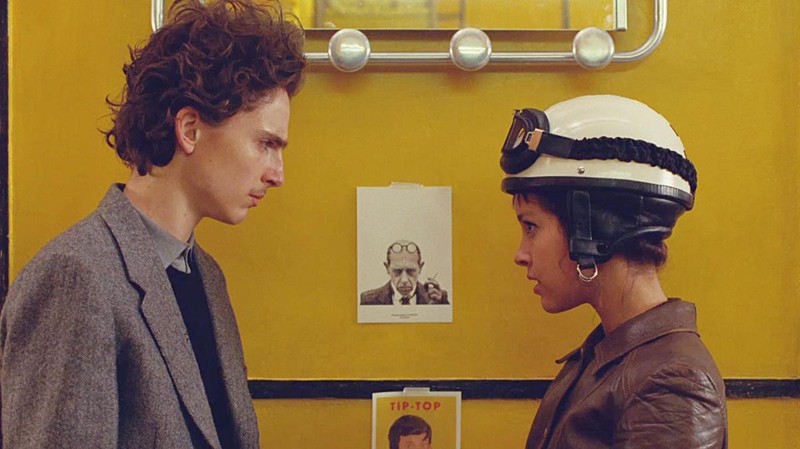
Generally, I find Anderson’s films beguiling in the moment of watching, but invariably leave the theatre dissatisfied and grow steadily exasperated with him and with myself. “That’s the last Anderson film I’m going to see,” I usually vow (the same always happens with the latest Tarantino) But with The French Dispatch, I wasn't beguiled, I was bored, actually falling asleep two-thirds of the way in (I don’t know how it ends, if ending there be). Still, I was awake long enough to be irritated by the treatment of the young radicals of the late ‘60s. (And it seems clear that a similar sort of mockery is intended with the triptych's plotline about the imprisoned murderer turned abstract painter – another kind of radicalism, the primal expressivity of the outsider artist, is made to look silly).

It's not an especially original or penetrating insight to say of Anderson that he's besotted with the décor of the past but uncomprehending when it comes to a past period as a passion play of conflict and struggle, aspiration and idealism. Typography, uniforms, customs, procedures, design, accoutrements, appliances – the exquisiteness of form and formality is fetishized, each and every visually scrumptious scene screams to be freezeframed so that you can pore over its symmetries and color coordination. But as for everything else – the real energies that motor history, the tensions and turmoil bubbling behind the prettiness of the past - Wes is useless. Nothing is quite real, nothing really hurts (a great film wounds you, makes you ache with the wish that the fate of the characters could have been otherwise – or that you could ever in your own paltry life feel a fraction of what they've felt).

One thing Anderson does seem to share with Fellini is a great fondness for the bustle of minions and underlings. The punctilious spectacle of people briskly going about their business, the tasks associated with their allotted place, wearing the uniform appropriate to their station and function, pulling rank or doffing the cap when required. Officials, bell boys, able seamen, scout leaders, maids, maitre d's. It’s a view of society as a caste system – the high and the lowly, predestined, to the mannerisms born.

His films often resemble a Richard Scarry Busy Busy World book (all those cute cutaway cross sections of the interiors of buildings, ships, planes!) soaked through with the aristocratic nostalgia of an Evelyn Waugh. Look at how charming the world looks, when everything is in its place and everybody knows their place.


The clockwork elegance of socially stratified space – all those moving parts cogging together as a smoothly running hierarchy – in Anderson’s movies reminded me of yet another film I’ve seen recently: Playtime. I’d never seen a Jacques Tati film before. The little glimpses I’d caught convinced me that this was a comedic world I’d never want to spend time inside. Too whimsied, too mild and minor a pleasure. But something – the memory of a DT recommendation, its warmth but none of its actual specifics - made me click on Playtime when it presented in the Criterion menu. I watched it without advance knowledge of what it was about, a virgin state quite hard to arrive at these days, and one to take advantage of should it occur. And I was entranced. Only to discover later that my reaction to the film was almost the opposite of how you are supposed to take it.


I don’t know what Tati’s politics were - probably not unlike Fellini's (moderate... keeping his distance from ’68, unlike some of his Italian cinematic contemporaries... a supporter of the Christian Democrats). But it’s funny how today’s eyes can look at this shimmering vision (filmed in 70 mm, for twice the richness and detail of standard film, it’s seen best on a gigantic screen, an opportunity to be seized should it present itself) in a completely opposed way to the creator's intent.
Apparently, when the film finally came out, it was fatally out of step with the mood of France / Europe / the West circa 1968. As DT notes, “anger is one of those emotions expressly missing from Playtime”. That’s from his “Have You Seen….? review of the film. Earlier, in the entry on Tati in The New Biographical Dictionary of Film, DT harps on the satiric intent of Playtime, Trafic, Mon Oncle, finding their critique of “the brutality of progress” to be “tritely thought out and endlessly reiterated.”
But by the later volume, he appears to have revisioned Playtime and his response to it is remarkably – and pleasingly – close to my first-time reaction. Here, writing in 2008, he rejects the idea that it should be understood as a work of “social criticism that deplores modern times”. Instead, the look of the film – meaning how it looks at the world, rather than its décor – is a “tranquil, amiable gaze… There is nothing like the inclination to see ugliness, or unkindness, that actually builds pathos in Chaplin. Rather, Tati is charmed by the existence of things in space…” . The camera is “backed away, at an amazing (and amazed) distance” and the overall effect is that “the sense of beholding the turmoil of life is irresistible…. Yes, this society is accident-prone and deserves to collapse or destroy itself, but its energy, its persistence, is beautiful and inspiring. It’s like watching cells grow and divide. What alarmed 1968, I suspect, was the authentic optimism of the film, its exhilaration…”

Although their metaphors for life and the world are different - for Fellini, it's the circus or the cartoon; for Anderson, the cutaway / diorama; for Tati, in at least this film, it's the amusement park or funfair - they do all have in common versions of this "tranquil, amiable gaze", a sense of "the impossibility of critique", or its unnecessariness, an unconflicted view of life.
And there's nostalgia at work in all three films - but a different kind in each.
Amarcord is proper rose-tinted nostalgia, selective memory retrospection - the ugly parts of the past largely sidelined in the warm glow of memory.
The French Dispatch is the sort of nostalgia that isn't really nostalgia (because there's no algia as such, no pain or ache). Retro at its purest, making contact with the past only through pastiche. The screen suppurates with a surface-deep fetish for the historical (decor, clothes, typography, etc) but there's no feel for History. (As Fredric Jameson put it in his Postmodernism book of '91: "The return to history everywhere remarked today… is not a return exactly, seeming rather to mean incorporating the 'raw material' of history and leaving its function out, a kind of flattening and appropriation").
Playtime - well, there's two nostalgias here, the nostalgia of its creator and the nostalgia of a certain sort of contemporary viewer (such as me). Tati's nostalgia takes the form of a bemused-amused scepticism about modernity and neophilia (the rapid replacement of old architecture and old ways of doing things, in all their charm and familiarity). But over a half-a-century later, the film becomes susceptible to a retro-modernist nostalgia. Its stirs wistful feelings about the optimism and confidence of the immediate decades after WW2. C.f. Rem Koolhaas on the late 60s as humanity's highpoint: the Moon Landing, Concorde's launch, the Osaka Expo, grand projects pursued by a "public sector... with vision".
^^^^^^^^^^^^^^^
Bonus beat: DT on WA, from The New Biographical Dictionary of Film: Sixth Edition
"I liked [Rushmore] very much but felt already that The Royal Tenenbaums had a kind of whimsical pretension that can mark and beguile a student who has given up on being educated. Thus, the agonies of family dysfunction have been chilled by a kind of visionary novocaine, itself pleasing and very much of the moment, but with one drawback: that the sense of dysfunction (and thus failure) could be reassessed or tamed as mere oddity.... The comparison with Paul Thomas Anderson is a signal. PTA's films have been odd and disconcerting at times, but overall they leave no doubt about the maker's sense of trying to make films in a time of immense physical and cultural crisis. By contrast, WA seems to exist at the far end of a very private, isolating corridor. Moonrise Kingdom seemed to exist on an island at the far end of that corridor: it was pretty, whimsical, and consistent, but what was its point?"


