(i own this book - have yet to dip into very far - Soviet futurologists, scientists, etc circa 1968 imagine the future - not one imagines there'd be no more USSR)
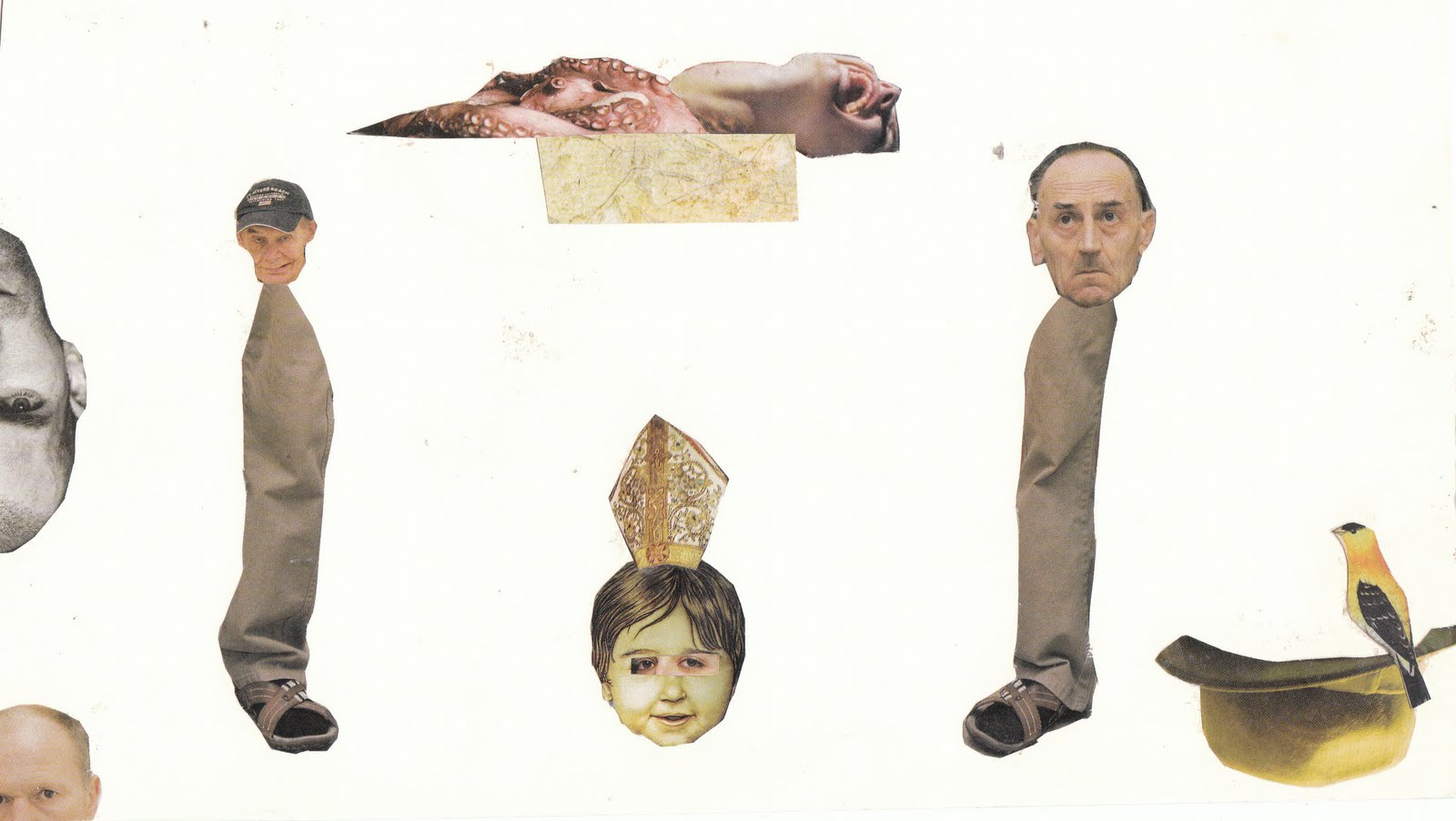
"Sammy Slabbinck began buying midcentury magazines in his teens. It was the early Nineties and every weekend he would scour the flea market in his home town of Bruges" now 38 - "He keeps them in teetering stacks on the top floor of his house. “I have no idea how many I have,” he says, speaking from Bruges. “Thousands perhaps? Many thousands. It’s become an addiction.”
"Playboy and Paris Match offer particularly rich pickings for Slabbinck’s art, as do the many women’s lifestyle titles popular in the Fifties, Sixties and Seventies. He often combines them with books and encyclopedias from the same period. "They all have, he says, “a certain look and feel, with very strong lines. You can see it in the architecture, the cars, the furniture. But the photography is also completely different: it has a quality which I find very innocent. The colours are faded and warm, the images have a soul. It’s nothing like the photographs you can take now with a super digital camera and millions of pixels. I tried making collages with recent magazines but they just don’t have the same spirit.”
You don't remember the Hypnagogic Collages of yore?
At The Conversation, a short essay by Emma Smith - a professor of Shakespeare Studies - about the memorialisation glut and "the right to be forgotten"
"Three US neuroscientists published a case study in 2005 detailing how a woman... was plagued by memories of her own life and of public events such as the dates of death of Elvis and Princess Diana.... The researchers named this case “hyperthymestic syndrome”, from the Greek thymesis, remembering... It’s clear that we all live in this age of hyperthymesis.... The paradox of the digital future is the burden of the past that we are constantly archiving.
".... Some 78% of theatres digitally preserve and archive their productions by capturing their live productions and make them available online. In this archival process, the word “live” is under some pressure. “Live” streaming of theatrical events into cinemas is morphing towards designing productions specifically for the camera rather than the theatre audience.... The availability of recorded theatre online has increased substantially over the past 18 months: it won’t be long before almost all theatre productions are available online....
"Rather than always looking to record and archive we might want to reinstate the idea that being “live” demands impermanence, ephemerality and forgetting.
"Forgetting – or half-remembering – is the way we collude with art to make it our own. We construct our own “highlights package” that is unique to our own often faulty memories of an experience....
"Remembering, not forgetting, is the enemy of creative reinvention"
One of the things I was really pleased to squeeze into Retromania was a bit on Erkki Kurenniemi - the Finnish futurist polymath who from the 1960s got involved in a whole range of experimental electronic endeavours involving computers, robotics, music, film and much more - and who had a great documentary made about him, The Future Is Not What It Used To Be by Mika Taanila
So imagine my delight, a few years ago when I made a trip to Finland to stumble quite accidentally on a retrospective exhibition of Kurenniemi's work in multiple media being staged at a big art museum in Helsinki.
Blurb at MIT: "Over the past forty years, Finnish artist and technology pioneer Erkki Kurenniemi (b. 1941) has been a composer of electronic music, experimental filmmaker, computer animator, roboticist, inventor, and futurologist. Kurenniemi is a hybrid—a scientist-humanist-artist. Relatively unknown outside Nordic countries until his 2012 Documenta 13 exhibition, ”In 2048,” Kurenniemi may at last be achieving international recognition. This book offers an excavation, a critical mapping, and an elaboration of Kurenniemi’s multiplicities.
The contributors describe Kurenniemi’s enthusiastic, and rather obsessive, recording of everyday life and how this archiving was part of his process; his exploratory artistic practice, with productive failure an inherent part of his method; his relationship to scientific and technological developments in media culture; and his work in electronic and digital music, including his development of automated composition systems and his “video-organ,” DIMI-O. A “Visual Archive,” a section of interviews with the artist, and a selection of his original writings (translated and published for the first time) further document Kurenniemi’s achievements. But the book is not just about one artist in his time; it is about emerging media arts, interfaces, and archival fever in creative practices, read through the lens of Kurenniemi." Had a peruse through Writing and Unwriting and it looks really fascinating stuff
here's my bit from Retromania for your further enticement and edification:
... Imagine a Finnish hybrid of Stockhausen,
Buckminster Fuller and Steve Jobs--who from the 1960s onwards was a pioneer in
electronic music, computing, industrial robotics, instrument invention, and
multimedia. Short of presiding over Finland's space programme, he was involved
in every aspect of the Future.
Rediscovered and championed by the Finnish techno outfit Pan Sonic,
Kurenniemi's clangorous bleepscapes such as "Electronics In the World of
Tomorrow" (1964) compare favorably with the avant-classical creations
emanating from Paris and Cologne during that time. He was also something of a
techno-prophet, talking in the voice-over to 1966's "Computer Music"
about how "in the 21st Century people and computers will begin to merge
into hyperpersonas. It will be hard to say where man ends and machine
begins."
The documentary-- made by
director Mika Taanila.... also looks at
what became of Kurenniemi in the twilight of his career. Grey-bearded and careworn, the aging
innovator spends most of his time documenting himself. He takes 20 thousand
pictures a year, which are carefully touched-up and filed on his computer. He
inputs "cassette diaries" he made during the Seventies and records
new ones detailing the minutiae of his existence, like the good steak he
enjoyed courtesy of a friend.
Why? Kurenniemi believes that medical advances
will virtually eliminate mortality in the not-too-distant future. "Mine is
probably the last generation of mortals".
200 years from now, when the greater part of humanity lives off-world,
in the asteroids or orbital zones, while the Earth is "a museum
planet", he believes that the indolent immortals, confronted by "100,
000 years of uneventful life" and "with nothing else to do but study
old archives", may be "genuinely interested in reconstructing the
20th and 21st centuries." Kurenniemi's
"manic registration" of every trivial detail of his life is intended
to provide the "core material" for this resurrection project. In the near-future, it will be possible to do
"brain back ups", to download consciousness and personality into a computer.
But Kurenniemi can't count on lasting
that long. So, he advises, "we just have to keep every tram ticket and
sales slip, and write down or record all our thoughts." Video would make
for a better imprint of his consciousness, a document of the world seen through
his eyes, but it's impractical; the still snapshots will at least provide a
"jerky account". He plans on doubling his current rate of 100
pictures a day.
Erkki Kurenniemi's journey from
future-minded visionary working at the interface of science and art, a
fresh-faced young man who pioneered computers and robotics and kept one bright
eye always on the stars above, to the
haggard and slightly potty sixty-something frantically collating the remains of
his days for the benefit of some future race of curators, strikes me as a perfect parable for our
times.