Showing posts with label NOSTALGIA. Show all posts

Tuesday, April 9, 2024

Great, Scott

"The nineties were better than the eighties, and one key reason was that there was less originality. Originality is unmusical. The urge to do music is an admiring emulation of music one loves; the urge toward originality happens under threat that the music that sounds good to you somehow isn't good enough."

Scott Miller, Music: What Happened? 

A clever thought - inspired by a song by Smashing Pumpkins of all things ("Cherub Rock")

Elsewhere, he picks up the theme:  

"As you know, I kid the 1980s. I wonder can it possibly be fair to condemn an entire decade as a horrifying decline in every kind of musical competency, but nostalgia for the Eighties baffles me. Eighties nostalgia has lowered my opinion of nostalgia. So you're right, I was unconsciously targeting that kind of decline with "What Happened?" But pop music is great in that a true decline fosters a true pop response, like R.E.M. Eighties music suffered from a coliseum spectacle mentality, and R.E.M. reached around that with a sort of small-combo, home-spun literary connection approach."


Music: What Happened?   - well, it's a view of music very different from mine... we do converge on early R.E.M., but it's a rare occurrence in  Scott Miller's year-by-year inventory + commentary on the best  best songs between 1960 and the end of the 2000s. (He carried on commenting on the year's output online, until his tragic too-early death in 2013).  Even when his approbation lands on a band I love, he often picks a song by them I don't rate or actively dislike. 

But it's a wonderful book to read for that very reason - full of unexpected insights and precision description of a song's moving parts, informed by his being a musician (Game Theory, The Loud Family) and operator in a scene (loosely,  college rock) that had its own distinct metric of evaluation (craft, structure, daintiness to a degree.... cleverness as a pure value... melody above all, but understood in a particular sense, that sense defined by the inside-out - in my view - position that the tunes of Grant Hart were better than the tunes of Bob Mould).  

So yes the '80s canon is dBs, Let's Active, XTC, the bleedin' Smithereens...  and by the '90s  (The Posies, Jellyfish, They Might Be Giants) it's getting even further from both my own aberrant pantheon and the mass idea of what pop is....  by the 2000s, it's beyond marginal. 

But Music: What Happened? - despite the implied, "it all went to shit" in that title -  reads neither as contrarian nor embittered, but as simply the eloquent expression of another way of listening, another kind of loving. 

Check it out here

Here's a review by Michaelangelo Matos that goes into Miller's methodology in the book (each year's harvest relates to a CD comp of his favorite tunes released that year).

A playlist of damn near every song that makes up Miller's personal pantheon

And one that goes from 1980 to when he left off in the early 2010s - what you might call A College Rock Canon

Interview with Scott by Matthew Perpetua.

There's a bit in it riffing off the Smashing Pumpkins / originality comments: 

Scott Miller: I don’t want to create the false impression that the more derivative a piece of music is, the more I like it. But liking something because it’s new is never a musical response. Music carries a lot of potential for emotional impact that is not musical impact. As a simple example, a moving set of lyrics may have more or less the same impact if you just read them. Five minutes of sound might have dramatic impact, and five minutes of compositionally vapid music in a film score might work great to telegraph a set of emotions and surprises to go with the scene. But a purely musical response always needs an existing music context. You can’t play Andean flute music to Rush fans and expect the value to be apparent in isolation, or vice versa. There’s a world of context needed by the ear to support a musical reaction. I like originality in music, but that is a non-musical reaction.

Matthew Perpetua: How often do you think originality actually occurs? I tend to think that it usually comes down to the personality of the artist more than the formal aspects of things, which are usually lost on non-musicians. I found it interesting that you chose the Smashing Pumpkins as the vehicle for this thought because while that band didn’t really invent anything, I would think that to some extent there is originality there simply because Billy Corgan is such a one-of-a-kind figure. If nothing, he has this distinct voice and persona.

Scott Miller: That’s a very good observation. On the artist side, there are gestures intended to be taken as originality, and on the listener side, there are experiences of novelty, and they might not match up at all! One of the most tried and true formulas is for musicians to strive mightily to do something as well as their heroes, but while failing miserably at that, arriving at something close enough for a certain size audience to relate to, but with a whole new aspect of appealing sound that simply came from who they are.

^^^^^^^^^^^^^^

Tuesday, June 20, 2023

retrotalk2023: "reunited and it pays so good"

" Your Fave Band Is Reuniting – But Not For the Reasons You Think" - an attempted marshalling of rationales for the legacy act festival / reunion boom, by Danny Wright at Vice

I must say I don't disapprove of this kind of thing nearly as much as I did when I wrote Retromania. "Disapproval" isn't quite the right term, anyway - "distaste" is more like it.  I could empathize with the reasons bands did this kind of thing. What else are they supposed to do with themselves?). Money - you can't blame 'em really, mortgage payments to keep up. Plus there's that resolution of interband conflicts/ friends reconciled / writing a happier end to the story than the probably messy and bitter split-up.  The distaste was more about the idea of me being at one of these events, what it would feel like, and also the sense of being a target demographic. 

But, having gone to a couple of these elder-laden festervals in the last few years, I acquired a teensy bit of taste for this kind of thing (a certain queasiness lingers, though). The events are an intriguing mixture of amusement and bemusement. Simply as a sociological phenomenon, there's stuff to observe and to consider. What happens when a youth culture ages out? How weird does it get when subcultural types valiantly persist with the look, despite the attrition of the years. A mass elegy for one's bygone identifications and intensities. 

There's something salutary about being shoved amidst your own (approximate) kind. Seeing how everybody's grappling with decrepitude. 

Also, occasionally, there'll be some actually entertaining performances. Bands you never quite managed to see in their (and your) prime, but they can still pull it off. They might even be better on some level -  musicianship, having the experience and/or the budget to put on a great show.  

Hey, as I'm about to click post on this, the missus alerts to me an upcoming festerval that is trying to out-Cruel World Cruel World - Darker Waves.  Although the lineup isn't that Gothy in fact. 


I suppose what I wonder about is not the top three ranks of the line-up, but below that.... sub-legends (Clan of Xymox, Chameleons etc).  It can't be that rewarding, financially or in terms of ego, reconnecting with the compact following, having to play in the mid-afternoon. 

Also wonder about the musicians who join legends that have suffered personnel erosion... whose function is prosthetic.  (Like, are they any other original band members in "Psychedelic Furs" now, apart from Butler Rep?). I suppose it's a gig. You get to ply your trade. Maybe you were a fan of the leg in question. 


Thursday, June 15, 2023

magazine as time machine

" To Truly Understand the Past, Pick Up an Old Magazine" -  Brian Dillon in the New York Times writing about the way that reading old magazines (his examples are a 1984 issue of The Face and a 1965 issue of Vogue) immerses you in history in a way that dissolves the inherited and calcified ideas of what a decade or epoch was actually like. It's a battle between "edits" - the original selective version of the then-present as captured in that issue of the magazine, versus the edited-down version of the era that comes down to us through a gradual winnowing into hardened cliches and stereotypes, stage after stage of nostalgic retrospection and generalization. 

"What surprises me now in the pages of The Face: There are just the tiniest hints of the British miners’ strike and the swelling unemployment that are convulsing the country politically. And not a single mention yet of AIDS; in a Wrangler ad, a model’s speech bubble announces, oblivious: “I’m Positive.” In these magazine pages, it both is and is not the 1984 of my memory."


Dillon describes the way that everything about a vintage magazine - not just the obviously notable, signs-of-the-time identifying articles, but the adverts, graphics, listings, etc - is like a plunge into the (almost) raw material of an epoch. 

"When research takes me offline to libraries and archives, or (better) into the depths of a dusty eBay find, I can’t stop at the magazine or journal pages I was looking for; I want to read everything, from masthead to classifieds. Old magazines are cheap time machines, archaeologies of collective desire."

This is where my head has been at for a while now - at a certain point, I got far more excited by and interesting in gathering up ancient print music magazines than old records. Here's something I wrote in an essay for The Wire around the time Retromania was first published:

"Shopping for secondhand vinyl: I can’t be alone in too often chancing on an intriguing record and then being halted just shy of purchase by the thought: “Hmmm, I can probably find this on the Internet for free... save myself $15... do I really need another record cluttering up the house?” Digiculture has here damaged a multifaceted set of pleasures: the thrill of the hunt, the risk of taking a punt, the tactile delight of ownership.

"Curiously, revealingly, my crate-digging lust is shifting to another analogue-era object of desire: the vintage music magazine. Now and then on a blog you’ll come across a download link to a zipped file of scanned pages from an obscure fanzine or periodical, but for the most part these yellowing bundles of ink and paper have yet to undergo the fate of dematerialisation/dissemination that’s befallen almost the entirety of recorded music. Part of the sudden allure of old magazines is, I’m sure, that they retain a scarcity value that records have forfeited (at least in terms of pure sonic information: the physical records obviously retain potent fetish appeal in terms of packaging, the period flavour of the design and the label, etc).

"But there is also a more elevated aspect to the attraction. Packed with uncommon knowledge, these vintage magazines provide the kind of information that’s hard to find on the internet owing to the particular way its archiving system is structured. Online, you can uncover a vast amount about an artist in terms of diachronic trajectory (discography, biographical arc). Much harder to reconstruct is the synchronic context: what was going on at the precise moment in time of a record’s release, whether in terms of the genre in which the group operated, the general state of music culture, or the political and social backdrop. A musty, yellowing 1970s copy of NME or Melody Maker, Creem or Let It Rock, is a precious capsule of circumstantial evidence: reviews and features about contemporaneous groups, but also record company adverts and the graphic design and typography, which ooze period vibe. You can’t fully understand the impact of glam rock without a sense of how drab and style-less regular rock groups looked then, of how visually depleted the whole media environment was. Likewise, the stark angular minimalism of post-punk groups and record covers derived its salient edge from juxtaposition with scruffy Old Wave and Stiff-style pub rock. 

A time-slice of history, stubbornly analogue, the vintage music magazine in some sense resists the decontextualising vortex that is netculture, that endless end of history that never stops churning. "

Actually, nowadays you can find a lot of whole issues of vintage magazines in pdf or online form - there's a list of repositories in the side bar of my own vintage music writing blog Pantheon.

Dillon again: 

"Carry on reading, however, past famous names and images that seem most of their time, and you find the past does not look or sound as you imagined or recalled.... Of course, you might come away from such pages smirking at the fashions, assumptions and ambitions of the past — or with a nostalgic ache for its objects, textures or habits of speech. But also a sense that the past is never the past of present cliché, any more than our present is purely itself, entirely made of the self-celebrating now." 


Saturday, May 27, 2023

The Rift of Retro - pinpointed!

Trying to pinpoint the Rift of Retro, the date kept shifting back.

 Initial thought was circa 1983-84, when postpunk's forward drive entropized and left-field musicians and fans started listening en masse to 1960s records like Byrds and Velvets and Love, the effects audible in the likes of R.E.M. and Smiths and a swarm of jangly groops.

But this initial thought was very quickly adjusted as I remembered glam's pomo-in-all-but-name referentiality.... and then the parallel, overlapping but discrete phenomenon of the early 70s rock'n'roll revival. The huge spate of '50s nostalgia....

But then upon further reflection I realised that started even earlier -  as early as 1968 with The Beatles's "Back in the USSR", Zappa's doowop pastiche project Reuben & the Jets. At the start of that year there was talk in the music papers about a return to rock'n'roll basics, and the beginnings of a nostalgia circuit with '50s acts exhumed, many original rock'n'roll greats announcing their first tours of the UK in ages.

Just the other day someone posted on Twitter a Melody Maker article that pushes the date of the Rift back even further - albeit only a few months. It's from September 1967 and reports on an unexpected  interest in early rock'n'roll records. The Birmingham record retailer interviewed says that "it started about six months ago". So that further pinpoints the Rift to March '67


Of course, an interest in older music, nostalgia, these things per se are not really retro as I'd define it. Retro is when a current group spurns the contemporary and makes music that is a remake or a form of attempted time travel. So that would be "Back in the USSR", Reuben & the Jets, and other things of that time like The Move's "Fire Brigade" of February 1968 with its discernible Eddie Cochran flavor (possibly the first retro move made by a major group?). 

And probably not too long after that you would get the first of the groups whose wholesale music identity is revivalist - for instance, Shakin' Stevens and the Sunsets formed in 1969. 

(Although looking into the odd story of Shakin' Stevens, it seems he never "went back" to rock'n'roll - that was always his only love, he was a fanboy of a 1950s Welsh rock'n'roller called Rockin' Louie! Another tidbit - Shakey's manager was a member of the Communist Party and Shakin and the Sunsets played a fair few benefits for the CP of GB)


Wednesday, July 6, 2022

retrotalk1974 - "You Can't Go Home Again"


There's been a surprising uptick in retrotalk recently - hence the Retrotalk2021 and Retrotalk2022 series. I've also done "Pre-Echoes of Retromania" posts about prior spurts of retro-talk in the '90s, and the '80s. Moaning and groaning about nostalgia and revivals has an extensive and a long-established history. Anxiety about it seems to come in waves then fade back into the background (perhaps because of a surge of newness in the music culture).

 Well, here below is an example of vintage retrotalk - an excellent 1974 essay by Michael Wood that originally appeared in New Society. It's the first piece in a 1977 Fontana collection of articles from New Society . 

(Which magazine should really be archived on the internet - look at the lineup of contributors here: Reyner Banham, John Berger, Angela Carter, Dennis Potter, E.P. Thompson.... People like these and Simon Frith and so forth were writing on a weekly basis about arts and culture and social trends + issues all through the '60s, '70s and '80s, from a left-wing, Brit-centric perspective. What a trove of discourse, all inaccessible unless you have academic privileges at a UK university, I should imagine). 

(I have actually contributed to New Society in a certain sense, having written for the New Statesman around the time it absorbed New Society - for a while the amalgamated periodical went by the name New Statesman & Society, if I recall right). 

Michael Wood is a Brit-born professor at Columbia University in New York (then) and later at Princeton. At the time of the Fontana collection's publication he'd written a couple of books including one titled America in the Movies. Later came The Magician's Doubts: Nabokov and the Risks of Fiction among other titles. 


There's also this quote in the introduction by Paul Barker:

'One cumulative effect of mass communication nowadays is that, though transient in intention, it more and more puts itself on record. So the music, manners, and modes of the past are instantly and synchronously to hand in a way they have never been before. Revivals of style can go with ever-gathering speed. The cycle, rubbish-camp-acceptable-antique, has now become almost totally telescoped. Mass communication is like the memories in a mind half-asleep. Or like your mind when drowning? In everything, the mass media are flatteners and foreshorteners, like zoom-lens photography. Every high street with the same advertised brands; every newscast with the same news; every singer with the same tune. Even what is local becomes merely another candidate for mass consumption : good for a joke by Eddie Waring on It's a Knockout.'


A couple of further examples of 1970s nostalgia discourse in the mass media


Thursday, June 30, 2022

retrotalk2022 - Get Back as time travel

And here's some retrotalk from yours truly - a discussion with Francesco Tenaglia for The Music Folder,  a talk-series curated by Archivio Storico Ricordi, which investigates the intersection of music, memory, and arts. This was done a little while ago, so the focus initially is on the recently-shown Get Back 8-hour Beatles documentary series and the uncannily persistent dominance and prominence of the Fab Four in our culture (chiming with Luke Turner's swipe at Maccagemony in the previous post). Then the retrotalk moves onto curatorial and annotative culture, obituary and elegy writing, the deejay as archivist, completism and collectoritis, my work as a teacher....  You can find the audio of our discussion here and a marginally tidied-up transcription here


Tuesday, June 28, 2022

retrotalk2022 nostalgia deathgrip

Stone the crows, here's yet another piece on retroculture -  this time by Quietus-man Luke Turner, writing for New Statesman.

 It bears the headline: "Macca and the Stones? The past has a death grip on our culture" and it starts by noting that "if you include the holograms, this week nine musicians with a combined age of 686 – Paul McCartney, Elton John, the Rolling Stones and ABBA – are once again the biggest cultural news in the UK"

Amusingly, Turner notes right near the top of the piece that "to attack nostalgia is nothing new. More than a decade ago, the critic Simon Reynolds published Retromania, an incisive look at a musical culture that seemed to wallow in ironic takes on the past rather than aspiring to anything fresh." Mark Fisher gets his due props too. 

But Turner wants to have it both ways - see things  from the viewpoint of the ahistorical young, "for whom it is all new, right now" and who feast on the atemporal banquet of streaming blahblahblah. 

He wants to be negative and positive simultaneously (difficult trick) and so as well as  complaining about rockpop's gerontocratic oliogopoly and their full-spectrum dominance of the attention economy, he also points to new shoots of growth -  small but teeming shocks-of-new still out there to be found (the kind of thing covered in the Quietus - the New Weird this or that)

I sympathise: nobody wants to be the old grouch if they can help it.  


Tuesday, May 17, 2022

Decline of the Wes, or, Three Movies, Three Nostalgias


The other day I finally watched Amarcord – a Fellini film I’ve been meaning to see ever since learning that it was an influence on Eno’s On Land. Couldn’t quite see that connection, beyond the nostalgia (Eno for the Suffolk of his 1950s and ‘60s childhood,  Fellini for his 1930s Adriatic adolescence) but nonetheless was utterly beguiled by the film’s year in the life of a fictional coastal town. Then I immediately picked up, as I so often do, Have You Seen…?, to find out what David Thomson has to say.

DT tears the film apart! “The word amarcord means ‘I remember’, but the mood of the film is more that of someone saying ‘I wonder’, trying to forget harsh times or ugly truths… Nothing hints at why fascism had come to Italy, or at the process that would remove it. Fellini knew that bad time, of course, but Amarcord is a case of leaving nostalgia uninspected….  It is a display of charm done without much shame. It reminds us, perhaps, of Fellini the cartoonist, watching life go by and turning it into lively comic sketches… Fellini once was a real social observer and storyteller. Here he is a mere collector of material. He has withdrawn enough from story to give up its urge to judgment. So Amarcord discourages history or political thinking. The Fascists came like the snow or the blossom; you shrug and wait for the next season.”

Floral Mussolini meets the flower of Italian youth

Oddly, as so often, I enjoyed DT’s dismissal of a film without it affecting my enjoyment. The two  continue to coexist quite comfortably.

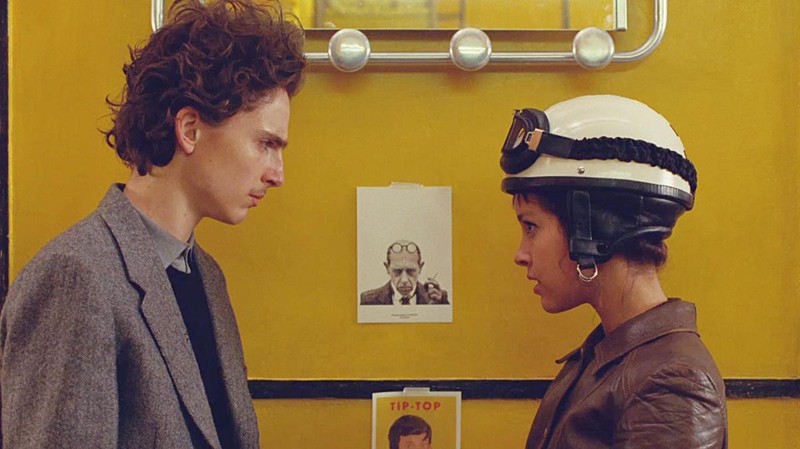
One phrase in DT’s delicate dismemberment of Amarcord – “I do think there’s a conscious effort to suggest that fascism is an adolescent ideology” – reminded me of another movie I watched recently, also belatedly: The French Dispatch. I don’t know if Wes Anderson is a fan of Fellini, let alone influenced by him, although they do share a love of décor and costume (but then who doesn’t in modern movie-making – films, and TV, are caked in the stuff). There are many modes in which an infatuation with the sumptuousness of surfaces can be expressed. Still, that line about “an adolescent ideology” snagged my attention, because that is what Anderson does with May 68 and student radicalism: he makes it out to be merely an outbreak of trendy immaturity.


One of the slogans graffitied on the city walls in The French Dispatch's version of 1968 is: "les enfants sont grognons", which translates as "the children are grumpy."  Revolution is equated with teen fads like yé-yé music and with dance moves and hair styles in fashion for a micro-season. The very idea of manifesto-writing (big ideas about changing society, about art or life) gets rendered ridiculous by the petty prissiness of proof-reading. 


Frances McDormand's character, the journalist observer, ventriloquises the director's viewpoint when she delivers a lecture that essentially tells the girl and boy student leaders to put away childish things. Instead, she instructs them to go off and go to bed together (the idea is that this is "what they really want" - in other words, social discontent and political fury are just pent-up libido). Confirming their immaturity, it's revealed that both the boy and the girl are virgins. Their lack of experience points to  unworldliness -  they don't know how the world works. All their hot air about borderless utopias stems from a profound innocence that's embarrassingly gauche. 

Generally, I find Anderson’s films beguiling in the moment of watching, but invariably leave the theatre dissatisfied and grow steadily exasperated with him and with myself. “That’s the last Anderson film I’m going to see,” I usually vow (the same always happens with the latest Tarantino) But with The French Dispatch, I wasn't beguiled, I was bored, actually falling asleep two-thirds of the way in (I don’t know how it ends, if ending there be). Still, I was awake long enough to be irritated by the treatment of the young radicals of the late ‘60s. (And it seems clear that a similar sort of mockery is intended with the  triptych's plotline about the imprisoned murderer turned abstract painter – another kind of radicalism, the primal expressivity of the outsider artist, is made to look silly).

 It's not an especially original or penetrating insight to say of Anderson that he's besotted with the décor of the past but uncomprehending when it comes to a past period as a passion play of conflict and struggle, aspiration and idealism. Typography, uniforms, customs, procedures, design, accoutrements, appliances – the exquisiteness of form and formality is fetishized, each and every visually scrumptious scene screams to be freezeframed so that you can pore over its symmetries and color coordination. But as for everything else – the  real energies that motor history, the tensions and turmoil bubbling behind the prettiness of the past -  Wes is useless.  Nothing is quite real, nothing really hurts (a great film wounds you, makes you ache with the wish that the fate of the characters could have been otherwise – or that you could ever in your own paltry life feel a fraction of what they've felt). 


One thing Anderson does seem to share with Fellini is a great fondness for the bustle of minions and underlings. The punctilious spectacle of people briskly going about their business, the tasks associated with their allotted place, wearing the uniform appropriate to their station and function, pulling rank or doffing the cap when required.  Officials, bell boys, able seamen, scout leaders, maids, maitre d's.  It’s a view of society as a caste system – the high and the lowly, predestined, to the mannerisms born.


His films often resemble a Richard Scarry Busy Busy World book (all those cute cutaway cross sections of the interiors of buildings, ships, planes!) soaked through with the aristocratic nostalgia of an Evelyn Waugh. Look at how charming the world looks, when everything is in its place and everybody knows their place.


The clockwork elegance of socially stratified space – all those moving parts cogging together as a smoothly running hierarchy – in Anderson’s movies reminded me of yet another film I’ve seen recently: Playtime.  I’d never seen a Jacques Tati film before. The little glimpses I’d caught  convinced me that this was a comedic world I’d never want to spend time inside. Too whimsied, too mild and minor a pleasure. But something –  the memory of a DT recommendation, its warmth but none of its actual specifics -  made me click on Playtime when it presented in the Criterion menu. I watched it without advance knowledge of what it was about, a virgin state quite hard to arrive at these days, and one to take advantage of should it occur. And I was entranced.  Only to discover later that my reaction to the film was almost the opposite of how you are supposed to take it.


It was intended -  everyone agrees on this -  as a satire of a sterile, technocratic society emerging in the Sixties, the "tomorrow's world - today!" of  chrome and glass and plastic, where functions are pointlessly automated at every turn, just for the sake of it, for the future-now frisson of it. Barely a trace of Nature or the old Paris is left in this ultramodern metropolis.  This is the standard, accepted view of Playtime: see this recent capsule by Richard Brody in a New Yorker list of the greatest independent films of the 20th Century: "Jacques Tati built a skyscraper city—not full-sized but surprisingly close—on the outskirts of Paris for this wildly ambitious comedy of the regimentation and disorientation that the architecture of technological modernity imposes on its users, the human disconnections that it inflicts, and the anarchic spirit of revolt that it inspires.

Utterly unaware of how its creator intended Playtime to be taken, I took it as something completely different: a total rhapsody to modernity.  No doubt this is an accidental byproduct of today's nostalgic fetish for mid-century aesthetics, the look of graphics and appliances in the 1950s and early '60s. But as a result, I watched Playtime in a Wes sort of way, I suppose (showing perhaps that the "decadence" in Anderson's work that aggravates me is really me recoiling from my own capacity for irony and detachment, resisting being seduced by surfaces). 

 Thanks to a protracted and involved production process (Tati constructed a gigantic set involving multiple city blocks and high-rise buildings) Playtime finally came out in 1967, but if I hadn’t known that I would date it 1961 from the look of people’s clothes and hair, the furniture and interior décor of offices, shops, apartments and restaurants. Fairly instantly I was reminded of Donald Fagen's The Nightfly, his nostalgic evocation of early Sixties optimism in songs like "I.G.Y." and "New Frontier", the "graphite and glitter" of  the near-future paradise that technology and automation will bring.  Maybe it’s a case of the auteur’s intent being undercut by the erotic logic of the camera, so the work ends up saying something else, or saying two opposed things simultaneously.  But the Paris of Playtime seemed like a shiny wonderland. 

And yes, Tati has humanity bumbling along, not quite able to get with the program that its best and brightest minds have laid out, the messiness and clumsiness of ordinary people getting in the way. Also what screws up the planning is the sheer Frenchness of everyone, which seems to rush in to fill the vacuum in a cityscape studiously evacuated of everything traditionally Gallic (apart from the flower lady and some of the food). Nationality as this stubborn ineradicable force, a recalcitrant drag against the International Style of corporate modernism.


 I’d almost read the film as an accidental riposte to the Situationist et al critique of soulless technocracy and urban planning and the emptiness of consumerism (although actually it seems to be  the case, that Tati was roughly on the same page as Debord and crew, at least in terms of his animus). The characters wandering bedazzled and disoriented through the steel and reinforced concrete maze  could be taken as  psychogeographers re-enchanting the city through dérive.


I don’t know what Tati’s politics were  - probably not unlike Fellini's (moderate... keeping his distance from ’68, unlike some of his Italian cinematic contemporaries...  a supporter of the Christian Democrats). But it’s funny how today’s eyes can look at this shimmering vision (filmed in 70 mm, for twice the richness and detail of standard film, it’s seen best on a gigantic screen, an opportunity to be seized should it present itself) in a completely opposed way to the creator's intent.

Apparently, when the film finally came out, it was fatally out of step with the mood of France / Europe / the West circa 1968. As DT notes, “anger is one of those emotions expressly missing from Playtime”. That’s from his “Have You Seen….? review of the film. Earlier, in the entry on Tati in The New Biographical Dictionary of Film, DT harps on the satiric intent of Playtime, Trafic, Mon Oncle, finding their critique of “the brutality of progress” to be “tritely thought out and endlessly reiterated.”

 But by the later volume, he appears to have revisioned Playtime and his response to it is remarkably – and pleasingly – close to my first-time reaction. Here, writing in 2008, he rejects the idea that it should be understood as a work of “social criticism that deplores modern times”. Instead, the look of the film – meaning how it looks at the world, rather than its décor – is a “tranquil, amiable gaze… There is nothing like the inclination to see ugliness, or unkindness, that actually builds pathos in Chaplin. Rather, Tati is charmed by the existence of things in space…” . The camera is “backed away, at an amazing (and amazed) distance” and the overall effect is that “the sense of beholding the turmoil of life is irresistible…. Yes, this society is accident-prone and deserves to collapse or destroy itself, but its energy, its persistence, is beautiful and inspiring. It’s like watching cells grow and divide. What alarmed 1968, I suspect, was the authentic optimism of the film, its exhilaration…”


Although their metaphors for life and the world are different - for Fellini, it's the circus or the cartoon; for Anderson, the cutaway / diorama;  for Tati, in at least this film, it's the amusement park or funfair - they do all have in common versions of this "tranquil, amiable gaze", a sense of "the impossibility of critique", or its unnecessariness, an unconflicted view of life. 

And there's nostalgia at work in all three films - but a different kind in each.

Amarcord is proper rose-tinted nostalgia, selective memory retrospection - the ugly parts of the past largely sidelined in the warm glow of memory. 

The French Dispatch is the sort of nostalgia that isn't really nostalgia (because there's no algia as such, no pain or ache). Retro at its purest, making contact with the past only through pastiche. The screen suppurates with a surface-deep fetish for the historical (decor, clothes, typography, etc) but there's no feel for History. (As Fredric Jameson put it in his Postmodernism book of '91:  "The return to history everywhere remarked today… is not a return exactly, seeming rather to mean incorporating the 'raw material' of history and leaving its function out, a kind of flattening and appropriation").

Playtime - well, there's two nostalgias here, the nostalgia of its creator and the nostalgia of a certain sort of contemporary viewer (such as me). Tati's nostalgia takes the form of a bemused-amused scepticism about modernity and neophilia (the rapid replacement of old architecture and old ways of doing things, in all their charm and familiarity). But over a half-a-century later, the film becomes susceptible to a retro-modernist  nostalgia. Its stirs wistful feelings about the optimism and confidence of the immediate decades after WW2. C.f. Rem Koolhaas on the late 60s as humanity's highpoint: the Moon Landing, Concorde's launch, the Osaka Expo, grand projects pursued by a "public sector... with vision".

^^^^^^^^^^^^^^^


Bonus beat: DT on WA, from The New Biographical Dictionary of Film: Sixth Edition

"I liked [Rushmore] very much but felt already that The Royal Tenenbaums had a kind of whimsical pretension that can mark and beguile a student who has given up on being educated. Thus, the agonies of family dysfunction have been chilled by a kind of visionary novocaine, itself pleasing and very much of the moment, but with one drawback: that the sense of dysfunction (and thus failure) could be reassessed or tamed as mere oddity....  The comparison with Paul Thomas Anderson is a signal. PTA's films have been odd and disconcerting at times, but overall they leave no doubt about the maker's sense of trying to make films in a time of immense physical and cultural crisis. By contrast, WA seems to exist at the far end of a very private, isolating corridor. Moonrise Kingdom seemed to exist on an island at the far end of that corridor: it was pretty, whimsical, and consistent, but what was its point?"

Friday, March 4, 2022

"Retrokultur-Experte"

Well I suppose I am, aren't I? And in that capacity I chatted with Ann-Kathrin Mittelstrass of German Public Radio for a program about retro trends of the present, the Nostalgie-Epidemie, etc, including the Beatles Get Back mega-doc (which I loved-loved and meant to write about here but then the moment passed). 


Wednesday, January 19, 2022

retrotalk2022 #2 - nostalgia

Alexandra Fiorentino-Swinton asks "how can we ever be nostalgic for media that never ends?". It's part of Real Life's column series New Feelings, which is "devoted to the desires, moods, pathologies, and identifications that rarely had names before digital media." 

“While much has been made about the overload of nostalgic pop cultural mining in music, fashion, and other media content, the very structure of our most prevalent plot devices indicates a cultural atmosphere of temporal erosion. Fictional plots today may be taking our increased continual connectivity into account, eschewing the tight contours of the singular, removed adventure narrative that once defined youth media...  In contrast to the “analog era” movies that featured encounters with “hard nostalgia” — idealizing youth as a bittersweet place of departure, as something that is over just as it’s happening — my experience of youth media is one of continuity. Movies and TV shows today account for continuing digital connectivity in their use of equally weighted character perspectives, stop and starts of individual storylines, and a default industry-wide push (granted the viewership numbers) toward a stream of sequels and reboots. In popular entertainments marketed to me, stories are supposed to go on forever — bolstered by endless spin-offs and fan extensions....  An entire cottage industry has emerged out of finding nostalgic and referential easter eggs in these kinds of films, reifying the iconic nature of what came before as it is continuously brought into the present. They survive on the commodification of their own history — and so do we, in a social sphere that mirrors the entertainment sphere: in ongoing curation, narrativization, and calculations of value in an algorithmic setting."


Saturday, January 1, 2022

retrotalk2021 #7

 Here's a new study of nostalgia and retro culture from Zer0 books  - Alessandro Gandini's Zeitgeist Nostalgia: On Populism, Work, and the 'Good Life'


Release rationale: 

"We live an age of nostalgia, incarnated by populist fantasies of “taking back control” and making nations “great again". In the long aftermath of the 2007-08 economic crisis, nostalgia has been established as the cultural zeitgeist of Western society. Populist fantasies of nostalgia represent a cry for help against the demise of the societal model of the postwar era, based on stable employment and mass consumption. The promise of an impossible return to the 'good life' of the 20th century, Gandini contends, particularly appeals to the older generations, who are incapable of making sense of the evolution of Western societies after decades of globalization and neoliberal policies. The younger generations, in the meantime, are instead trying to build a new 'good life' based on another form of return, this time to old practices of craft production and consumption."

So more about retro-politics - Brexit, Trump, and similar "make ___ great again" / neo-traditionalist moves in Europe - than about, say, retro-pop as in hologram tours, artists stealing from the 80s/90s/early 2000s, etc.  And  about hipsterism and its consumption patterns as a rejection of dematerialised lifestyles but expressed more in the realm of  Etsy / micro-breweries etc than the music domain of vinyl fetishism, the antiques market for analogue synth hardware, etc. 


Monday, November 16, 2020

anemoia

"More interesting still is that nostalgia can bring to mind time-periods we didn’t directly experience. In the film Midnight in Paris (2011), Gil is overwhelmed by nostalgic thoughts about 1920s Paris – which he, a modern-day screenwriter, hasn’t experienced – yet his feelings are nothing short of nostalgic. Indeed, feeling nostalgic for a time one didn’t actually live through appears to be a common phenomenon if all the chatrooms, Facebook pages and websites dedicated to it are anything to go by. In fact, a new word has been coined to capture this precise variant of nostalgia – anemoia, defined by the Urban Dictionary and the Dictionary of Obscure Sorrows as ‘nostalgia for a time you’ve never known’."
- from an essay by Felipe de Brigard in Aeon magazine

"In 1985, the psychologist Endel Tulving in Toronto observed that his amnesic patient ‘N N’ not only had difficulty remembering his past: he also had trouble imagining possible future events. This led Tulving to suggest that remembering the past and imagining the future were two processes of a single system for mental time-travel. Further support for this hypothesis came in the early 2000s, as a number of scientific studies confirmed that both remembering the past and imagining the future engage the brain’s so-called ‘default network’. But in the past decade, it has become clear that the brain’s default network supports mental simulations of other hypothetical events too, such as episodes that could have occurred in one’s past but didn’t, atemporal routine activities (eg, brushing teeth), mind-wandering, spatial navigation, imagining other people’s thoughts (mentalising) and narrative comprehension, among others. As a result, researchers now think that what unifies this common neural network isn’t just mental time-travel, but rather a more general kind of psychological process characterised by being self-relevant, socially significant and episodically, dynamically imaginative. My suggestion is that the kinds of nonautobiographical cognitive contents associated with nostalgic states are instances of this broader category of imaginations....

"Consequently, nostalgia can be associated with a possible past one didn’t experience, a concurrent nonactualised present, or even idealised pasts one couldn’t have lived but nevertheless can easily imagine by piecing together memorial information to form detailed episodic mental simulations..."


Wednesday, December 25, 2019

Friends, again

"We spend our days in front of screens which broadcast us more information than we’re able to handle about things we aren’t able to change. Is it any surprise that safe and familiar relics are being dug up to soothe us?" - Olivia Ovenden

What with being Mr. Retromania, I am quoted in Ms. Ovenden's Esquire piece "The Pull Of The Past: How We All Got Hooked On Nostalgia In The 2010s", an interesting deep dive into the memory-surfacing algorithms of social media etc, with a particular focus on Nineties-nostalgia and the widespread recourse to Friends as a sort of televisual eqivalent to ambient / Ambien.


Monday, September 16, 2013

cassette nostalgia and lost purity


An interesting, and interestingly self-contradictory, "meditation on the merits of the cassette tape," by Nick Sylvester, originally posted at Pitchfork on the eve of Cassette Day.

Although Nick vows not to bang on about the lost tactile tangibility of the format, or its analogue-smudgy "warmth",  he does nonetheless assert that "there’s no format more human than the cassette. No format wears our stain better. I have not encountered a technology for recorded music whose physics are better suited for fostering the kind of deep and personal relationships people can have to music, and with each other through music. This sounds like nostalgia... but I don’t think it is. I’m talking about new music, on cassettes, in 2013. No audio format keeps me more focused on listening to the thing itself, without the distraction of having a web browser right in front of me, without the baggage of an ersatz music news cycle, the context upon context, the games of the industry. Music released on cassettes doesn’t feel desperate or needy or Possibly Important. It tends not to be concerned about The Conversation. It resists other people’s meaning. That’s what I like about the cassette. It whittles down our interactions with music to something bare and essential: Two people, sometimes more, trying to feel slightly less alone."

So it's the idea of a format that, while stained with our individual humanity, is uncontaminated by the Larger Discourse About  Music (including, but not limited to, the game of hip). A longing for a pure form of listening and direct, unmediated response to music.  Unmediated not just by the Music Media, but by the distorting prism of one's own self-reflexivity and self-consciousness.

This becomes even more clear when Nick reflects on his career in music reviewing (which started in 2002) and how that rapidly led to disenchantment.

"In hindsight, I underestimated how much the simple act of writing about music would rewire my brain and alter my relationship with it. I listened differently than before. The euphemism was “I was listening smartly.” But all that meant was I listened for good sentences. I read music like a text, but wasn’t exactly hearing it anymore. Deliberately misunderstanding something often made the writing better, and I did that a lot too. I abstracted music into ideas about music. Slowly the latter became more important to me than the music itself. I also became an incorrigible asshole, but that’s for a different piece. I never hated music, and I only loved writing about it. But I came to resent how I was listening."

I can't really remember a time when I didn't "listen for good sentences". Perhaps as a child listening to pop on the radio or my parents's classical records like Holst's The Planets or Beethoven's Pastoral Symphony. But certainly long before I started writing professionally I was writing about it in my head, through being such an avid reader of the music press. And I do doubt that this "pure state" of response to music, even if it once existed, can be recovered. Sooner or later, some kind of rudimentary ideas about What Music Is, What Music Is For, "good music versus bad music" enters into one's consciousness and intervenes between one's ears and the sound-waves.  You acquire some sort of system of judgement and an apparatus for placing things.  And the only way to turn that mechanism off, once it's lodged in there, is through extreme states of intoxication. 

Certainly even in my most casual, leisure-time, non-reflective states of musical enjoyment, sentences - good, bad, or indifferent - seem to  form themselves whether I want them to or not, regardless of whether I'm trying to form them. And they don't interfere with my pleasure, they are inseparable from it. A lot of the content of these blogs (well, mainly Hardly Baked) since we moved to LA comes from sentences sparked by songs, old and new, heard randomly and without purpose or agenda on the car radio. I don't experience this stream of involuntary thoughts and partially-formed language as a deformation of response;  it feels much more like an enhancement.

Sylvester's issues with self-consciousness got worse when he started making music, playing in a band that started to get somewhere.

".... I felt anxious pretty much all the time. Everything seemed to matter, down to the shoes we wore on stage. I became intimately aware of all the ugly industry machinations.... If music had once been a writing exercise, now it was a hunger game, with strategies that changed by the hour and a never-ending supply of supposedly make-or-break moments that might–might–one day land us a mid-afternoon slot at some gobots music festival. The entire setup of the music industry-- from the gross amount of power publicists had, to the convenient myth that musicians need to tour tour tour, next level next level next level-- seemed to benefit everyone except the people making the music. I only saw the wires now. I felt myself becoming cynical."

He posits making music for cassette release and listening to music on tapes as an escape from ideology into immediacy, freeing music from both ambition and the ever-more entangled web of discourse.

"Cassettes are my detox. A way for me to sidestep everything about music that isn’t music. To get back to the very basic propositions of why I make and listen to music in the first place."

The very inconsequentiality of limited edition cassette releases is liberating:

"I tell my friends I’ll record their music and we’ll put it out on cassette, and it changes the entire energy of the session. There’s less pressure. It’s less of an event than a vinyl release. It’s “just” a cassette... There’s a feeling of impunity. It’s not going to cost anyone too much money. Everybody goes for broke."
 

This all sounds quite, well, ideological, to me. The acts of listening to music and making music framed in very particular ways. And this becomes fairly blatant by the end:

"... I like to think that people who adore cassettes are at least partly like me: Enormous fans of new music, overwhelmed by the speed and context and game of it all. People who want a community, not a social network. People who want the music, not the meaning. Cassette people, I like to think, want romance and fantasy. A person in a room, making music, putting it in cassette-shaped bottles for no other reason than these cassette-shaped bottles tend to find the people who need their music the most. Total romance and fantasy, all of this, I admit it. But music could use more of both."

Nick doesn't really want music in some putative state of purity, stripped off all the extraneous meanings and projections. (If you did want that, you could find perhaps most easily with the mp3s and streams and so forth of digitized net-circulated music, where sounds can be totally decontextualised and virtually authorless).  Nick actually wants music enwrapped in "romance and fantasy." The supplement of discourse, far from being superfluous and damaging, is actually a vital enchancement. Theory as the spice of pop life.

And the long, interesting, interestingly self-contradictory piece he's written is the proof of that. Because music has moved him to form sentences. A whole bunch of sentences.