Showing posts with label HYPNAGOGIC. Show all posts

Tuesday, January 7, 2014

deja entendu

Pitchfork's  Jeremy D. Larson on "Aural Déjà Vu: How Oneohtrix Point Never and Colin Stetson Create Music Unstuck in Time":

"In the early days of scientific studies of déjà vu, a psychiatrist named Vernon Neppe defined it concisely as "any subjectively inappropriate impression of familiarity of the present experience with an undefined past."...  What is actually new sensory information... is being processed as old sensory information....   It may be mistakenly filed into the lobe that handles long-term memory, or there may be a delay in the visual signal getting sent to the brain. The sensation is a fantastic moment of confusion, where we can’t tell if we’re being nostalgic or prescient. And like just waking up from a dream, we try desperately to hang on to that disorienting feeling and figure it out, right up until it slips away from us and the lobes reconnect. I’ve found that my favorite 21st century music does this: confuses the lobes, confounds what is present and what is past into an "inappropriate impression of familiarity of the present with an undefined past." It creates something strikingly unfamiliar." 

Of Lopatin with his Ecco jams and R Plus Seven, Stetson with New History Warfare, and Dawn of Midi with Dysnomia, Larson asserts:  "by taking little sections of history and spinning them around, a little wobbly like a basketball on the finger, there is a hypnotic and incoherent sense of living in both the present and the past, unstuck in time "

Question: what happens when this approach itself becomes a cliche? (Vaporwave, yes I'm talking about you). When this zone builds up its own history behind it?  (Five years since hypnagogic O.1 stirred into being, and hard to believe but we're only year or two from it being a decade since hauntology kicked off!) When time-out-of-joint-iness becomes banalised through repetition and redundancy, to the point where "strikingly unfamiliar" itself becomes a new kind of familiarity?   Can this approach go forward, or is "forward" an obsolete concept, an inadmissible desire, in the new conditions?


Sunday, January 5, 2014

It's like hypnagogic / nu-NewAge never died!

A 2013 faves list that goes its own sweet way (and runs to over a hundred and twenty!) 


(Actually the hipness of yer actual old New Age seemed to resurge this year with the great I Am the Center private issue new age comp on Lights in the Attic, Emerald Web reissues on Finders Keepers, Iasos compilation  on Numero Group, and others I'm forgetting I'm sure... )

But as for current practitioners, vaporwave may be what's "hot", but it's good to see someone sticking with yer Panabrites and Pulse Emitters and Wave Temples's....

Been meaning to check out that Lievens Marten Moana musique concrete lp Music from the Guardhouse

Oneohtrix Point Never put out another long-player this year?! (The Fall Into Time). Sounds more in the vein of the stuff he started out doing, circa "Physical Memory" etc

Dig the cover of this Bitchin Bajas album

Thursday, August 15, 2013

not-so-New Age


So many operatives in the Zones of Alteration have moved away from hypnagogic 1.0 to hynagogic 2.0, i.e.  high-definition / digital-NOW! aesthetics, otherwise known as vaporwave. Indeed they did so a while back, following Ferraro's lead, such that there's already a vaporwave-backlash! D Check  this, that, and this: one-star and half-star reviews from Tiny Mix Tapes, until recently the great champion of all things V-wave. (Not forgetting its other great champion, our foremost taxonomist).  Commencing the slide in its stock profile,  this earlier TMT review - a tour de force of conceptual-reviewing - damned the genre with faint praise and fainter abuse.

But I expect VW will chunter on for a good while, as genres seem to do these days. The mystery of subcultural persistence (drum'n'bass is still being made in 2013) is now joined by the puzzle of  micro-generic obstinacy: hauntology chunters on, even coughing up twilight-era gems against the odds, while in postdubstep, "neon", first identified /christened circa 2009, appears to have cycled around into  sudden renewed relevance, or so we are led to believe).   

Another example: hypnagogic 1.0 has not gotten away either.  Defying high-def, the blurry, lo-fi  Nu-New Age sound of 2009-2010, which fetishised analogue from its synths to its cassette-tape format,  is still percolating in certain  quarters. As documented by this blog. 

And then there's this:

 I Am The Center: Private Issue New Age In America, 1950-1990 
Light In The Attic
October 29th

press release:

 "Forget everything you know, or think you know, about new age, a genre that has become one of the defining musical-archaeological explorations of the past decade.

I Am The Center: Private Issue New Age In America, 1950-1990 is the first major anthology to survey the golden age of new age and reveal the unbelievable truth about the genre.

For new age, at its best, is a reverberation of psychedelic music, and great by any standard. This is analog, handmade music communicating soul and spirit, often done on limited means and without commercial potential, self-published and self-distributed. Before it became big business and devolved into the spaced out elevator music we know and loathe today, this was the real thing.

From mathematical musical algorithms to airport murder mysteries to Henry Mancini and Bugs Bunny, the connections to mainstream culture run in curious directions. (Did you know, for instance, that a track from the first modern private press new age album is featured on the Blade Runner soundtrack? It’s called “Pompeii, 76 A.D.”, and we’ve got it here.)

I Am The Center is a knowing, but never cynical overview that invites listeners at last to the mainspring of a misunderstood genre’s greatest lights. Many of the biggest names are present — Iasos, inter-dimentional channeler of “paradise music”; Laraaji, discovered by Brian Eno playing for spare change in Washington Square Park; and the recently famous JD Emmanuel, icon to a new generation of drone, ambient, noise musicians. Call it what you will — before it was anything else, it was new age.

Lovingly conceived and lavishly presented, I Am The Center features stunning paintings by the legendary visual artist Gilbert Williams, and liner notes by producer Douglas Mcgowan, who weaves the words and images of the wizards and sorceresses of new age into a prismatic portrait of music that can finally be recognized for what it is: great American folk art."


2xCD housed in deluxe tip-on gatefold jacket with 44-page book
3xLP housed in slip case w/ 3 tip-on jackets, download card and 20-page book
Both formats with notes by Douglas Mcgowan featuring interviews with artists and includes rare archive photos.
Artwork by Gilbert Williams and Janaia Donaldson.
2 unreleased tracks, 7 others previously only on cassette


postscript - how about some post-post-vaporwave?

Thursday, April 11, 2013

Hauntologists taking the piss, or hauntologists having the piss taken out of them?

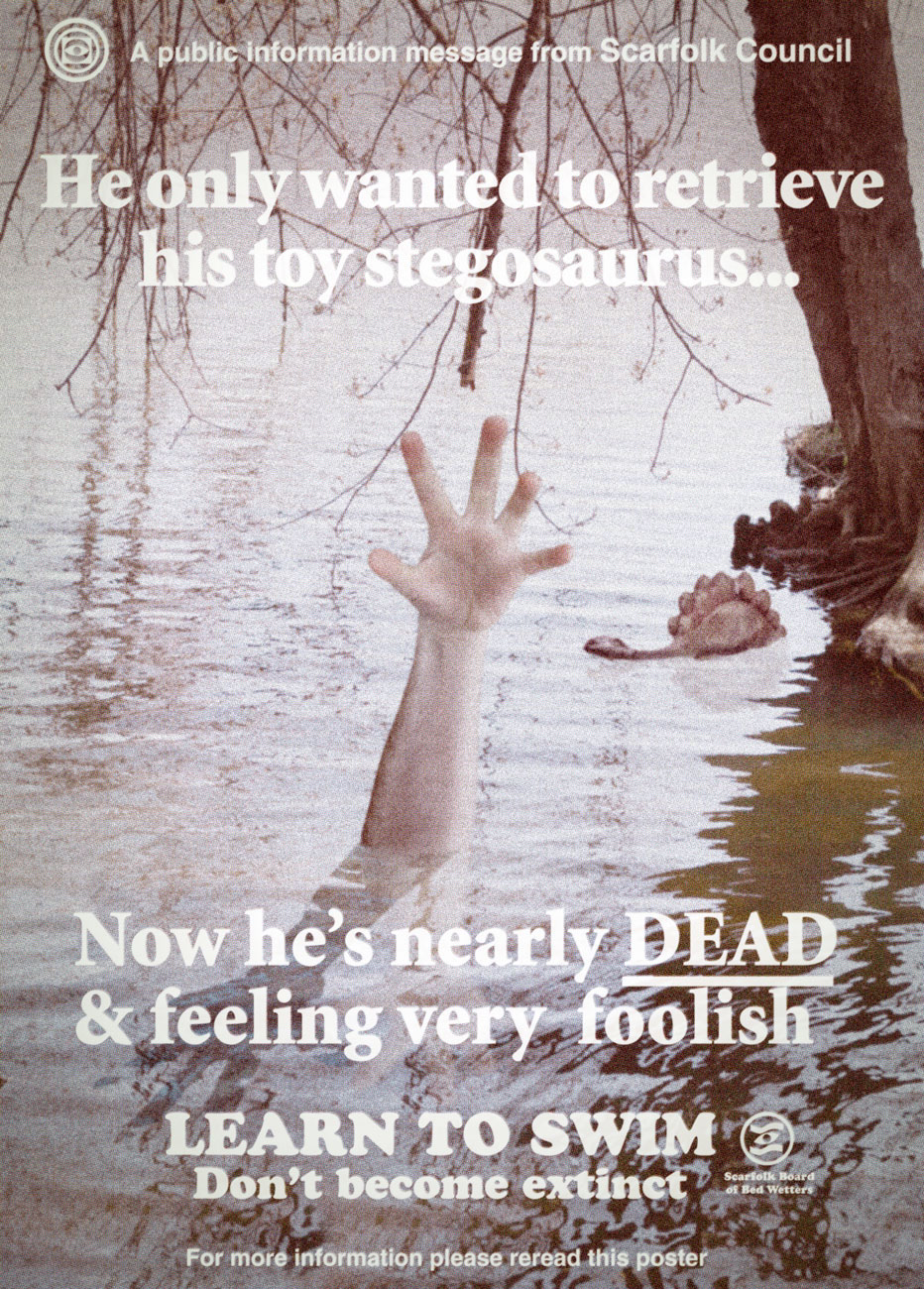
"Scarfolk is a town in North West England that did not progress beyond 1979. Instead, the entire decade of the 1970s loops ad infinitum. Here in Scarfolk, pagan rituals blend seamlessly with science; hauntology is a compulsory subject at school, and everyone must be in bed by 8pm because they are perpetually running a slight fever. "Visit Scarfolk today. Our number one priority is keeping rabies at bay." For more information please reread."

Jolly well done, either way:


 (via Our God Is Speed)


Ah, an interview with the creator Richard Littler indicates that in fact Scarfolk is in the sincerely-humorous spirit of imaginary towns like Ghost Box's Belbury or Moon Wiring Club's Clinksell, with  pedagogical/paternalistic imagery in the same vein as The Advisory Circle, D.D. Denham's electronic music for schools, etc

Still, as one commenter notes in the box at the bottom of that Creative Review interview, it's a wee bit disconcerting that neither Littler nor the interviewer acknowledges the precursors: "I  do very much enjoy Scarfolk, but I am surprised the questioning didn't ask how it related to earlier explorers of the same ideas (Look Around You, Ghost Box, Mordant Music's Disinformation remix of Public Information films for the BFI)...".  It is presented as if all this just occurred to Littler out of the blue.

But perhaps that's just a sign of our recursive / anterograde amnesia / Groundhog Day culture, that something that's already been around once or twice, can keep coming back again?

There is something appropriately undead about hauntology and its sister genre hypnagogic.

The dialectical march of music really ought to have superceded them by now (eight years on in the case of hauntology, even if we don't count precursors like Position Normal or Boards of Canada or Mount Vernon;  five or six years on in the case of hypnagogia). And yet they keep on coming: there's a new, excellent Focus Group album out next month;  vaporwave was hypnagogic 2.0;  Prince Rama's ghost modernism = hauntology merged with hypnagogic merged with stargaze...

The dialectic is precisely what has broken down in music, replaced by hyperstasis, or should that be hipsterstasis... 

Anyway, for now, feast your eyes....