Friday, May 12, 2023

Shuffle versus Click Wheel

 A recent-ish piece at Verge by Natalie Weiner argues that the shuffle button is the defining technology of the modern era of entertainment/media consumption. 

She traces its history back to the first CD players in 1982, when " Random playback was touted as one of the device’s best features." But notes that it really took a step towards the iPod / infinite jukebox idea with "the introduction of players that held multiple CDs; rather than just hearing a CD you owned play in an order you couldn’t predict, you could put a few that you liked together and, well, shuffle them, replicating the leanback experience of listening to the radio.... “Having a Sony CDP-C10 Disc Jockey in your home really is like having your own personal disc jockey,” another advertisement put it. “Ten hours of uninterrupted music enjoyment for hassle-free parties or background music in restaurants or shops.” 

The function combines surprise (whatever's next?) with safety (guaranteed it'll be something you've already enjoyed or are likely to enjoy). And it temporarily suspends the pressure of having to choose:  

"The introduction of the idea that media consumption could be both personal and passive had massive ripple effects. In the wake of the Napster era and its promises of a massive, totally unique music library, Pandora effectively invented the idea of individualized radio, promising the ultimate “shuffle” experience with technology that has since been used to great effect by streaming services intent on keeping people listening. Spotify, Apple Music, and their ilk offer both the promise of that Napster-scale range with Pandora’s ease. You could find anything, they suggest, but why not click this button and we’ll find it for you?"

My youngest son always put 'shuffle' on even when playing an album by an artist he loves - he prefers not to hear it in the right order, has no particular interest or respect for the sequencing decisions the artist has no doubt sweated over. I wonder if this is a common attitude among the youngers? 

I myself almost never use Shuffle (and generally spurn algorithmic guidance when using streamers or whatever). Which maybe why I think there's another contender in in terms of defining the modern era of consumer entertainment etc etc. the Click Wheel. (In Retromania, I refer to it as the iPod's scroll wheel and only realised Click Wheel is the right name!). In a recent conference talk on retro-culture themes, I used  the Click Wheel as a visual metaphor for hyperstasis: 

The wheel can scroll you to anywhere at incredible speed and fluency, so long as it is within archival space: the subdivided space of existing and already known music. 
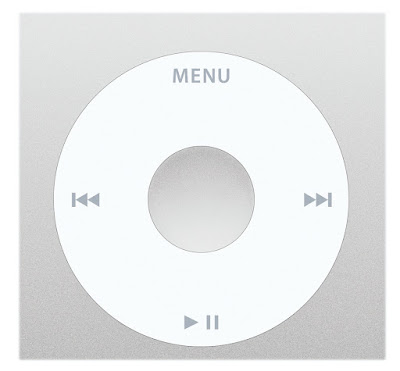
The iPod is now itself a retro piece of technology now (although I still use one when I go on a trip or use the exercise bike - occasionally late at night, if unable to sleep. Sometimes I wonder if I'm the only one left in the world still using the little black rectangle). 


Monday, May 1, 2023

retrotalk2023: the Nostalgia-Industrial Complex

 Pitchfork's Jayson Greene on what he's cleverly calling Music's Nostalgia-Industrial Complex - a tag that here describes the consolidation of song catalogues by legacy artists in money-minded hands looking to maximise every conceivable form of earning back on their huge investments in publishing rights.  

One way is to instigate the interpolation of hooks from these bits of prime musical property into songs that become Top 40 hits. Like this one:


"After clocking the 1987 smash’s internet infamy, Primary Wave acquired a percentage of the rights to [Rick Astley's "Never Gonna Give You Up"]....  then pitched the idea of an interpolation to Yung Gravy’s manager. At the same time, a member of Shukat’s team reached out to a producer who worked with Gravy. “Within a day, we literally had a track to listen to, and Gravy rapped over it two days later, which was fucking dope,” Shukat says over the phone. He was less enthused by the original track’s name—“Get Pussy”—and requested a rework, which was obliged. The song went on to peak at No. 30 on the Hot 100 and currently has more than 200 million plays on Spotify. When I observe that Shukat is describing a role more akin to a music producer than a publisher, he says, “I’m comfortable with that. We’re producing on a daily basis.” 

Primary Wave's chief of marketing is involved in the work of "'“artist re-development.' His team assembles three-to-five-year marketing plans for each new acquisition, and then presents a pitch deck to the artist or their estate."... Primary Wave treats their catalogs the way powerful record labels treat their star artists—except all of the publishing company’s talent is either dead, a legend, or both. And when you own the rights to some of the most important American popular music ever recorded, opportunities have a way of presenting themselves in perpetuity.

It's the wave of the (no-)future - retro-necrosploitation of golden oldies with proven hookability and nostalgic triggers in-built. 

"In the past few years, Primary Wave has been joined by what Shukat estimates are more than 20 similar companies. He points directly to the pandemic as the cause for the catalog stampede, which erased touring income from everyone’s ledger sheets for nearly two years. Now it feels like a week doesn’t go by without a major artist’s catalog getting scooped up."

Alongside Primary Wave, a company called Hipgnosis (unrelated I assume to the record design company) are big players in this field. 

"The rise in catalog acquisition helps to explain how we’ve arrived at a moment when the pop charts are littered with chunks of old intellectual property. Nicki’s “Super Freaky Girl” and Yung Gravy’s “Betty” are just two high-profile examples; you don’t have to look far for more. The Santa Clara, California rapper Saweetie’s “P.U.S.S.Y. (Powerful, Utopia, Supreme, Sacred, Yummy)” samples Mtume’s “Juicy Fruit,” the basis for Biggie’s “Juicy.” Atlanta’s Latto double-dipped Tom Tom Club’s “Genius of Love,” famously sampled on Mariah Carey’s “Fantasy,” for her song “Big Energy,” bringing in Mariah herself for bonus points." 

"... In some ways, the Hot 100 right now feels as recursive, all-encompassing, and allergic to new input as the Marvel Cinematic Universe. "

Thursday, April 27, 2023

retrotalk 2023 - the commemorative churn / retromAInia

From a little while ago, a piece at the Guardian by Shaad D'Souza that notes the shrinking of the turnaround time for commemoration - a trend for 5 year anniversary reissues and repackagings. 

"Keen to make the most of a seemingly steady revenue stream, labels have begun increasing production on limited and deluxe repressings of popular albums. Anniversary reissues – once only common to recently remastered records, or albums several decades old – are now becoming popular for releases that are just five years old, such as Cardi B’s Invasion of Privacy, Phoebe Bridgers’ Stranger in the Alps, Lucy Dacus’ Historian and Idles’ Brutalism. They’ve all been repressed in coloured formats or with alternate sleeves in the past two years, often at a slightly increased price point to standard black discs.

It’s in keeping with a frantically shortening nostalgia cycle that’s seen frenzied media coverage of supposed emo and “indie sleaze” revivals and music publications churning out cheap anniversary content – although these repressings seemingly offer little to the consumer other than a coloured disc. But Hannah Carlen and Ali Murphy – marketing directors for heavy-hitting indie conglomerate Secretly Group, which released Bridgers’ album – insist that fifth anniversary pressings allow artists to “give new fans something, and say ‘you’re welcome here too – you don’t have to be a day one fan’,” says Carlen.".... 

"The timeline of a record has changed so drastically,” says Ali Murphy. “Twenty years used to be the span of time in which people were celebrating a record, and now it’s got so much shorter, not only due to the quickness of everything coming out.”

C.f. my earlier post that detected an intensification of the commemorative churn with odd-number anniversaries of significant releases or events, and the odd habit of wishing dead icons or cult figures a happy birthday.


Another Guardian piece from a little while back (by Rich Pelley) looks at how a band of wannabes got AI to concoct a simulacrum of Liam Gallagher's vocals to front their own Fauxasis tuneage. "We got bored waiting for Oasis to reform" the culprits say - so they created something even more boring and redundant than Oasis actually reforming. 

“We’ve brought a band back from the dead!” says one of the band. “And I think that’s something we’ll see a lot more of.”

This is the future - mind-blowing technology being used to do mundane / inane  things.


Another AI phenom - AI-assisted upmixing - a 2023 clarification of "Sister Ray"


Sunday, April 2, 2023

The Science of Ghosts


Hantologie...


Two weeks ago I was in Taipei for a terrifically stimulating conference titled A Future Slowly Cancelled, mounted by the Taiwanese arts organisation C-LAB. Most of the papers touched upon Mark Fisher's work and notions like lost futures, hauntology, acid communism, etc (including my own keynote speech).

The night before the conference proper kicked off, there was a showing of a 1983 film that amazingly (I ought to have my Hauntological Association membership revoked!) I had never heard of: Ken McMullen's Ghost Dance.  And knock me down with a feather, who should pop up on screen, in a sort of acting role (playing himself), but ol' Jacques Derrida. It's 1983 but he's already talking the kind of ghost talk that would lead to Spectres of Marx, published a full decade later. 

Quick as a flash, I start taking phone pix of Derrida talking about ghosts -  the bright idea occurs to me that I can drop a few of these into the Google slide-show of my lecture just at the points where concepts like mal d'archive and hauntology feature. So it'll be the re-apparition of Derrida on the very same screen he'd appeared on the night before, mediated by the sort of tele-mediamatic technology of the digital era that JD alludes to  in Archive Fever (albeit glancingly so). Levels of image degradation  multiplied: faded made-for-TV video, shakily snapped on a mobile phone from a hasty distance, uploaded to Google, then reprojected in the lecture hall via my Chromebook. A ghost of a ghost of a ghost (of an actual ghost - a man no longer living). As academic wisecracks go, this ought to bring the house down.  (Well, in the event, not quite... )


Here's another scene with Derrida and the "heroine" in it (she's his student, but she... ) 


Jacques looks very debonair and dashing with his plume of fair hair. 


Now what is even more bizarre is that - although they don't share the screen at any moment - another major role in Ghost Dance is played by the young Robbie Coltrane.  Who could have dreamed it - Monsieur Archive Fever and the future-Hagrid, in the same Channel 4-funded art movie.


There's an odd sequence at the end where there's a kind of ghosting of images - the faces of Derrida and other characters appear on a seaside ridge of rock (ever so slightly redolent of the ending - or one of the endings, there are different versions, I'm talking about the TV version - of Videodrome).


Pascale Ogier - tragically soon to be a ghost (she died in 1984 aged only 26, of a heart attack)


Here's the whole film for the watching - a poignant flashback to the days when Channel 4 did adventurous and experimental programming. Lost futures, eh? 


There's some wanky overwrought bits, but many striking sequences and it's well worth a view, I'd say. Part of the slim corpus of hauntological cinema. 


Friday, March 10, 2023

Happy Deathday

 Aspects of retromaniacal culture seem to wax and wane (my overall feeling is that the R-thing is prominent but not quite as dominant as when the book was writ) but one phenom that seems to have gone into overdrive recently is the commemorative churn.

Two new syndromes I've noticed:

Odd-number anniversaries

 On Facebook and Twitter and probably the other social media that I don't frequent, it is becoming increasingly common to have people announcing or observing that is the 47th birthday of such-and-such a record, or that it's 23 years since a certain event. So not the usual number-ending-in-zero demarcations of elapsed time, or even the half-decade approach (25 years since, 45 years since), now we are getting these arbitrary, untidy anniversaries.  

Update 3/24 - slipped my mind that the previous post was spurred by a Robyn Hitchcock tribute to Syd Barrett on his 77th birthday! Which also fits the next category.... 

Birthdays of the deceased

This seems like an odd development (would you celebrate the birthday of a deceased person in your family or friend circle? Maybe you would, I don't know). But certainly, it feels somewhat.... extraneous to commemorate the birthday of some famous or notable person who's no longer around to bask in the celebratory appreciation. 

I feel like I've also seen a few deathdays being marked, so maybe that is creeping in. 

With a lot of this commemorative churn - and other retro material that is posted or circulated -  I don't think it's necessarily a product of nostalgia or aging demographic cohorts liking to re-mark the significant persons / artifacts / events of their pop consumer life... I mean that is a factor, but it's also a simple function of the churn of social media: the constant need for new material, for "news" (which in thise case is really "olds"). Even in as  busy a time as this (overloaded, over-observed, over-commented) and with as globally plugged-in a mediascape as ours, the present simply doesn't generate enough noteworthy material to keep everybody a-clicking and a-scrolling. 

It's also very easy to do. All it takes to commemorate something is a video clip or an album cover or an old photo, dash off a quick thought or not even that, just simply observe the fact that it's X number of years since ____ 

Then there's the endless lists of favorite movies and records (done by publications like Rolling Stone and Pitchfork, but also individuals and fan groups)  Like those challenges that circulate (1000 Records That Meant A Lot To You etc) or the self-surveys  (First Gig, Last Gig, Best Gig, Worst Gig  etc). Again, there is the simple content-generation aspect. But there's also an impulse to  sort through / tie together /  make sense of one's life in loving music / film / books.  Winnow down to the essentials and peaks. Create a  map of a journey through taste;  a consumer-biography.  I can't help sensing a morbid impulse lurking beneath this - almost like getting one's affairs in order in readiness for death. 

But I'm certainly not immune to this impulse -  indeed I'm something of a habitual and compulsive ranker, a list-o-maniac.