Tuesday, October 25, 2022

The Nostalgic Turn in Music Writing

Ted Gioia on the Nostalgic Turn in Music Writing

It starts with a photo, borrowed from the British writer Simon Warner, of the music magazine shelves in what looks like a typical W.H. Smith (my acquaintance with these generally occurs these days when passing through Heathrow). And indeed when passing through and stopping for a desultory pick-and-flick, I have noticed the profusion of titles to do with the musical past - sometimes precise slivers of the past (the '80s, more or less, with Classic Pop magazine; the '70s, more or less, with Prog) or a through-line across music, as with Electronic Sound, that seems to largely focus on pioneers of the past rather than anyone doing any pioneering today. Then there are all those special editions put out by Uncut and Mojo, one-offs that are midway between a magazine and a slim large-format book, and which are dedicated to a particular Canonical Artist and Their Discography - the contents mixing recycled interviews from the IPC or EMAP archives with new essays that go in depth on particular albums. (The only one I ever bought: Uncut's one on Joni Mitchell).

 This "Nostalgic Turn" does seem to be particularly intense in the UK - I haven't really noticed equivalents in US music publications, when I go and glance at the magazine stands at Vromans in Pasadena. 

Gioia on Warner's Brit newsagents photo: "Even the magazine names reveal a tilt toward nostalgia. I can’t make out the titles in their entirety, but I see the words Retro, Vintage, and Classic. Publishers are shrewd people, and they don’t put these words in large font unless the audience responds to them."

I don't think it's necessarily a Nostalgic Turn in Music Writing (although there are accumulated generations of writers still tapping away at the keyboards, and the older cohorts, like my own, will naturally tend to write about stuff that relates to their formative era more often than the current output). It's more like a  Nostalgic Turn within Music Magazine Publishing - a strategic adjustment to the fact that if there are niche markets still to service, they'll involve those who only really care about the past and who are happy to read and reread endlessly about their cherished icons. 

After all, even the impulse to pick up a solid-form print-and-paper magazines is a middle-aged and elderly proclivity. (I recently quizzed my students about their music-media diet - only one out of 20 ever looked at print mags, most didn't even read online magazines - news and views reach them through social media, YouTube reviewers, and, for a few, podcasts). 

Then you get the ostensibly "current affairs" music magazines, whose primary orientation is to the present output - but there's still a lot of Lists sorting through History and ranking classics - greatest ever dance songs, best songs of a particular year, or a particular decade, or All Time in a particular genre. And always loads of legacy artists being profiled and career-surveyed. Big box sets spurring a fresh spurt of reassessment. And then the tributes, the elegies, the obituary paeans. 

Gioia: "Things weren’t always like this. Go back and look at old issues of Rolling Stone or Downbeat or some other music magazine—there were years in which every cover story was about a living person and usually someone young with something new to say. "

As he acerbically points out, the cover stars of today are often the same cover stars of yesteryear - those old familiar faces, sometimes battered and worse for wear, but sometimes it'll be a back in the day photo of the artist in their youthful prime that gets used. 

 Gioa has some more general comments on an aversion to the new in the current music scene, based on the persistence of older records in the charts and other hard-stats kind of info. Then he offers this striking image: 

"It's almost as if the entire music distribution system is rejecting new songs the way a human body rejects an organ transplant. And we know where that inevitably leads—the host body’s death."


Saturday, September 17, 2022

retro-quotes #6868584 (the return)

"For stasis, as I intend the term, is not an absence of novelty and change — a total quiescence — but rather the absence of ordered sequential change. Like molecules rushing about haphazardly in a Brownian movement, a culture bustling with activity and change may nevertheless be static." 

from Leonard B. Meyer's 1967 book, Music, The Arts, and Ideas 

Friday, September 9, 2022

the word "retro" (an intermittent series)

When did the word "retro" enter common parlance? Or music-critical parlance?

My sense is that sightings of that word are rare before 1980.

Certainly back in the first half of the '70s, it was not a term in common use - when I read through all the Roxy Music coverage of that time, it never popped up once (even though it's nowadays a cliche to talk about them as retro-futurist).

Then in the early '80s, "retro" starts to crop up. It parallels the rise of a raft of phenomena that seem aligned with retro-spection: the emergence of what we would now call vintage; record fairs; the mushrooming number of reissue labels; the seepage of concepts like postmodern and postmodernist into the discourse. There was a term "retro-nuevo" that was bandied about in, I think, the mid-Eighties. 

Here's an early use of "retro" - Robert Palmer's  Retro Rock, a limited-edition vinyl release. It's listed in Discogs as follows: 

Robert Palmer – Retro Rock

Label: Clayton Webster Corporation – RR-82-20
Format: Vinyl, LP, Transcription
Released: Oct 5, 1982
Genre: Rock, Funk / Soul, Non-Music, Pop
Style: Classic Rock, Public Broadcast


A1 Give Me An Inch 2:47
A2 The Sailin' Shoes Medley 8:15
A3 Kid 2:53
A4 Work To Make It Work 4:27
A5 Gotta Get A Grip On You 3:27
A6 How Much Fun 3:18
B1 Jealous 3:28
Which Of Us Is The Fool Medley (10:47)
B2.1 Which Of Us Is The Fool
B2.2 We Got Love
B2.3 Pressure Drop
B3 Can't We Still Br Friends 3:10
B4 Got A Bad Case Of Loving You 4:42


At first I thought this was one of those publicity records that labels used to send to radio stations - to be played on air as if it were a real interview, or as promo just to sway deejays and producers. It has the look of a career to date recap - Palmer's greatest hits and non-hits. 

But actually it turns out that this is a vinyl document of a TV or radio broadcast. And it's the show that's called Retro Rock. And it seems to specialize broadcasting old concerts. This show was broadcast in October 1982 but the recording is from seven years earlier.   


But then there's some anomalies in this account - most glaring, how could Robert Palmer have performed a 1979 song by The Pretenders in 1975

The press release also references the performance including Palmer's "smash single" from a few years ago, "Bad Case of Loving You" . That was a medium-sized hit  in America in 1979. It was originally written and recorded by Moon Martin in 1978. Something is not right with this press release and the dating of the concert! 

If I was more familiar with Palmer's oeuvre I could probably spot some more temporal discrepancies. 


Tuesday, September 6, 2022

record collection rock


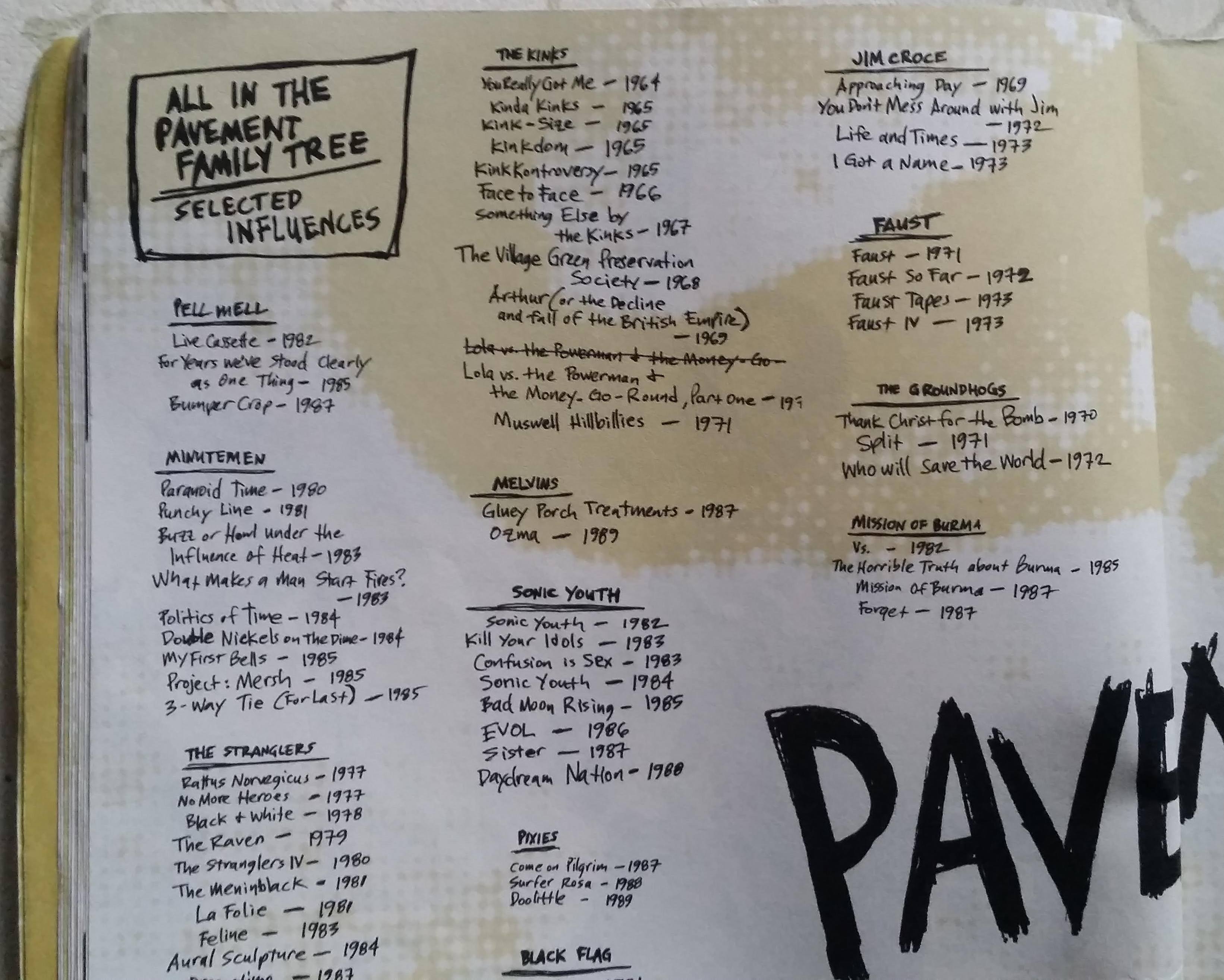
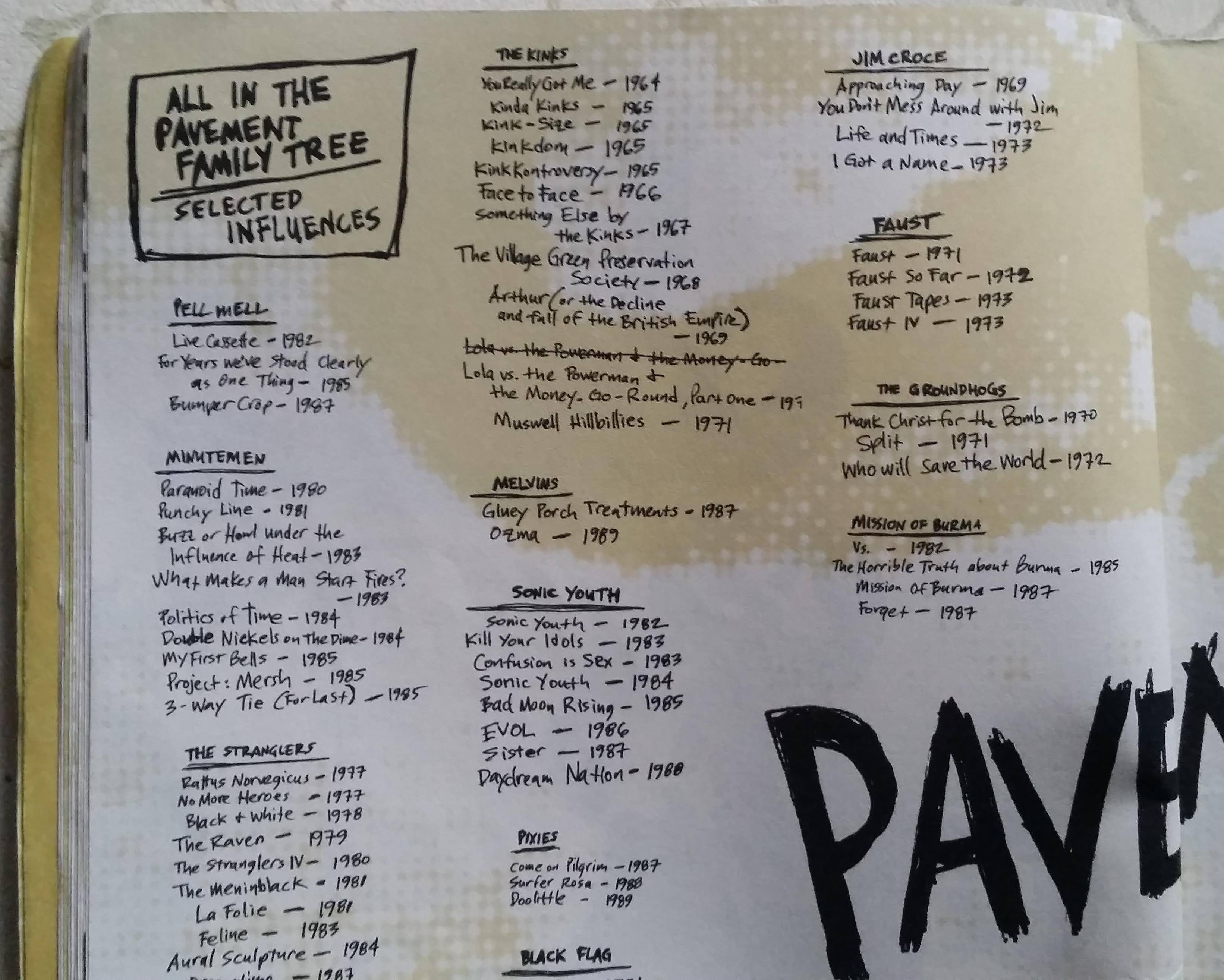
Not one of those Pete Frame rock family tree jobs, but an "influence map" of Pavement (who are currently gearing up for their 30th Anniversary Tour, jeepers) taken from Perfect Sound Forever, Rob Jovanovic's 2004 book 

Close ups:


Pavement - along with Saint Etienne, Urge Overkill, Teenage Fan Club and of course Primal Scream - were a key group for me in terms of  formulating the notion of "record collection rock".

For a while there was this regular column in Melody Maker called Rebellious Jukebox, a page where a musician would run through a list of records significant to them. Stephen Malkmus did one. Alongside the writing (or speaking? ) style and the tone (drily droll and couched in that slacker-ironical mode of the time) what struck me was that Steve seemed to have listened to everything. Every record that had ever come out. So one minute he'd be referencing 999 or some other second-division Brit punk group, the next it would be Sandy Denny or Fairport Convention.. There'd be a passing reference to Nurse With Wound or Nocturnal Emissions or something like that. He'd enthuse about Ege Bamyasi but perhaps some really obscure Krautrock would be cited too.  The piece was erudite - that's the only word for it. 

Thinking about it now, without the piece to hand (I've got it somewhere, in some folder or other), I feel there might actually have been serious gaps in the knowledge. Swathes of not-mentioned-at-all stuff : nothing danceable, electronic, or for that matter, Black.... pop too was absent. And indeed those things are all conspicuously missing from the Influence Map above. 

Still, the overall impression at the time of reading was that here was a chap, still only in his twenties, who had listened to EVERYTHING, had a take on EVERYTHING, and was capable of wresting enjoyment out of the utterly generic or desperately minor as easily as the obviously canonic and alternative-pantheonic. I didn't know at the time that some in Pavement had worked as record clerks, a job that would lend itself to playing anything and everything that came through the store, just for fun and curiosity and to fill time (also to annoy / bemuse the customers). That was one way to acquire a deep education in rock and its tributaries. Another way would be working at the college radio station, with its library of records and the flood of new freebies that would come in back in those days when college radio actually mattered and played a big role in alternative music promotion. 

But as well as vast knowledge, another byproduct of this immersion would be detachment - it's almost inevitably a byproduct of an omnivorous cultural diet. There were still some firm and sweeping opinions. In this piece, or perhaps another similar one, Malkmus opined that "you guys" (meaning the British) had had two great moments - early '70s folk-rock and the late 70s-early-80s postpunk DIY thing. But ultimately, increasingly, one's taste and listening got widened so much that strong allegiances or fanaticisms would not emerge.  

Very like Bob 'n' Pete in Saint Et, in fact - but being American and alt, obviously without the affection for chartpop. 

update 4/11/2023 - the column turns up courtesy of Nothing Else On. But I seem to recall another one as well with different references