Wednesday, June 27, 2018

Wednesday, June 20, 2018
Hauntology Parish Newsletter - June 2018: Moon Wiring Club, Bloxham Tapes, A Year In the Country, Andrew Pekler's Phantom Islands
Celebrating the Summer Solstice tomorrow, here's a new Moon Wiring Club mix!
Mr. Hodgson describes it as starting out as your "pretty standard hyper-soup of the usual 70s/80s audio synth nonsense with added vocal bitsy" that then veers into an unexpected "Industrial dance selection... everyone needs to have heard Soma Holiday at least once."
Mr. Hodgson also points out some related MWC action:
- a MWC interview that features in new "folk horror" book Harvest Hymns. Volume II - Sweet Fruits
- MWC track contributed to "3rd Wave" hauntology compilation, Present At The Terminal, on the Modern Aviation label
^^^^^^^^^^^^^^^^^^^^^
Mr. Hodgson mentions in passing a new 3rd Wave hauntology entity possibly worth checking out - Bloxham Tapes.
^^^^^^^^^^^^^^^^^^^^^
A Year In the Country have a new themed album involving multiple contributors out next month, The Shildam Hall Tapes, which sounds excellently eerie on a first listen.
Release rationale:
“Reflections on an imaginary film.”
In the late 1960s a film crew began work on a well-funded feature film in a country mansion, having been granted permission by the young heir of the estate.
Amidst rumours of aristocratic decadence, psychedelic use and even possibly dabbling in the occult, the film production collapsed, although it is said that a rough cut of it and the accompanying soundtrack were completed but they are thought to have been filed away and lost amongst storage vaults.
Few of the cast or crew have spoken about events since and any reports from then seem to contradict one another and vary wildly in terms of what actually happened on the set.
A large number of those involved, including a number of industry figures who at the time were considered to have bright futures, simply seemed to disappear or step aside from the film industry following the film's collapse, their careers seemingly derailed or cast adrift by their experiences.
Little is known of the film's plot but several unedited sections of the film and its soundtrack have surfaced, found amongst old film stock sold as a job lot at auction - although how they came to be there is unknown.
The fragments of footage and audio that have appeared seem to show a film which was attempting to interweave and reflect the heady cultural mix of the times; of experiments and explorations in new ways of living, a burgeoning counter culture, a growing interest in and reinterpretation of folk culture and music, early electronic music experimentation, high fashion, psychedelia and the crossing over of the worlds of the aristocracy with pop/counter culture and elements of the underworld.
The Shildam Hall Tapes takes those fragments as its starting point and imagines what the completed soundtrack may have sounded like; creating a soundtrack for a film that never was.
My memory is getting foggier as the years advance, but I think - I think - that I forgot to flag up this recent A Year in the Country release from just last month, Audio Albion
release rationale:
Audio Albion is a music and field recording map of Britain, which focuses on rural and edgeland areas.
Each track contains field recordings from locations throughout the land and is accompanied by notes on the recordings by the contributors.
The tracks record the sounds found and heard when wandering down pathways, over fields, through marshes, alongside rivers, down into caves and caverns, climbing hills, along coastlands, through remote mountain forestland, amongst the signs of industry and infrastructure and its discarded debris.
Intertwined with the literal recording of locations, the album explores the history, myths and beliefs of the places, their atmospheres and undercurrents, personal and cultural connections - the layered stories that lie amongst, alongside and beneath the earth, plants and wildlife.
^^^^^^^^^^^^^^^^^^^^
News from the parish's twinned town in West Germany - Andrew Pekler announces a new project entitled Phantom Islands – A Sonic Atlas . It is "an interactive online map that charts the sounds and histories of islands that were once found on nautical maps but have since disappeared."
Release rationale:
"Phantom Islands are artifacts of the age of maritime discovery and colonial expansion. During centuries of ocean exploration these islands were sighted, charted, described and even landed on – but their existence was never ultimately verified. Poised between cartographic fact and maritime fiction, they haunted seafarers’ maps for hundreds of years, providing inspiration for legend, fantasy, and counterfactual histories. Phantom Islands – A Sonic Atlas interprets these imaginations in the form of a map of speculative sounds from 27 phantom islands around the world.
Each track contains field recordings from locations throughout the land and is accompanied by notes on the recordings by the contributors.
The tracks record the sounds found and heard when wandering down pathways, over fields, through marshes, alongside rivers, down into caves and caverns, climbing hills, along coastlands, through remote mountain forestland, amongst the signs of industry and infrastructure and its discarded debris.
Intertwined with the literal recording of locations, the album explores the history, myths and beliefs of the places, their atmospheres and undercurrents, personal and cultural connections - the layered stories that lie amongst, alongside and beneath the earth, plants and wildlife.
^^^^^^^^^^^^^^^^^^^^
News from the parish's twinned town in West Germany - Andrew Pekler announces a new project entitled Phantom Islands – A Sonic Atlas . It is "an interactive online map that charts the sounds and histories of islands that were once found on nautical maps but have since disappeared."
Release rationale:
"Phantom Islands are artifacts of the age of maritime discovery and colonial expansion. During centuries of ocean exploration these islands were sighted, charted, described and even landed on – but their existence was never ultimately verified. Poised between cartographic fact and maritime fiction, they haunted seafarers’ maps for hundreds of years, providing inspiration for legend, fantasy, and counterfactual histories. Phantom Islands – A Sonic Atlas interprets these imaginations in the form of a map of speculative sounds from 27 phantom islands around the world.
"Explore the map by clicking on the names of phantom islands to learn the histories of their discoveries and the dates of their cartographical existence. Zoom in on individual islands to hear their musical, biophonic and geophonic soundscapes. Or, engage Cruise mode to be taken on an audio tour of all the Phantom Islands – ideal for passive listening in a separate browser window or tab. (In this mode, all the sounds, played in sequence, amount to something like my new album.) Recommended browsers: Chrome (version 67+), Firefox (version 60+ ), Safari (version 11+). Not usable on mobile devices.
"Phantom Islands – A Sonic Atlas was commissioned by Jeu de Paume for the exhibition Fourth Worlds: Imaginary Ethnography in Music and Sound and was produced with the support of DICRéAM, CNC. "
Wednesday, May 23, 2018
"like a wax museum with a pulse"
I should really have had a whole chapter on Quentin T in Retromania, shouldn't I?
Sunday, April 15, 2018
Hauntology Parish Newsletter April-May 2018: A Year in the Country book; Ghost Box new releases; Emotion Wave / Lo-Five; mediadropping; Starblood

The big news in the parish is the publication this week of A Year in The Country: Wandering Through Spectral Fields by Stephen Prince of A Year In The Country the blog and the label.
Sub-subtitled "Journeys in Otherly Pastoralism, the Further Reaches of Folk and the Parallel Worlds of Hauntology", it's an excellent compendium of Prince's musings and meditations on all things wyrdly bucolic, uncanny, and elegiac, spanning a spectral spectrum from Richard Mabey to Zardoz, Virginia Astley to Sapphire & Steel.

With the possible exception of Mark F's Ghosts of My Life, it's the first tome fully dedicated to all things hauntological (as opposed to various volumes about "folk horror" or 70s kids teevee)


^^^^^^^^^^^^^^^^^^^^^^^^^
In other parish goings-on, I have already mentioned the delightful debut album for Ghost Box from Portugal's Beautify Junkyards - The Invisible World of...
Fairly imminently there will be another fine album by The Advisory Circle - Ways of Seeing, out late May.
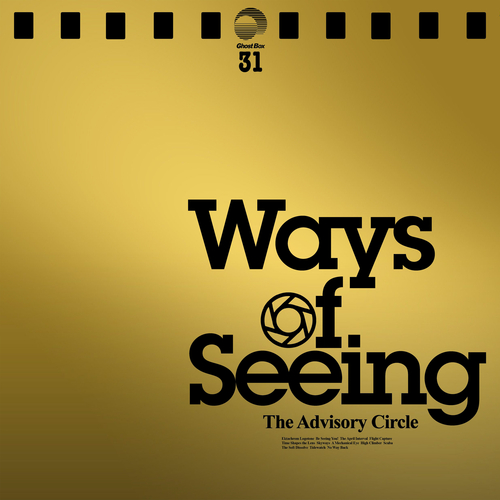
Through his own imprint Cafe Kaput, Circle chief Jon Brooks also recently put out this album
Neil Grant of Lo-Five - whose album When It's Time To Let Go for Patterned Air Recordings pleasured me last year - has set up a collective of Liverpool-based experimental electronic musicians under the rubric Emotion Wave. Here's Neil's project rationale .
Emotional Wave has some musical output already under its collective belt and I believe there is a non-audio entity (printed matter) in the pipeline. And in a week or so Neil releases the Lo-Five miscellany Propagate - remixes, compilation tracks and one-off specials.
Neil also alerts me to his having put out a little while back some "super lo fi house tracks" under the title My House Is Your House Volume One. Like Propagate, it's a tide-you-over / palate cleanser type release before the follow-up to When It's Time To Let Go.
Love the graphic echo of Human League's "Being Boiled" single sleeve there.
(Neil informs me that this was actually unintended - he just got the figures from a Letraset pack! A nice eerie echo nonetheless)
^^^^^^^^^^^^^^^^^
A rather tardy mention of an intriguing my-back-pages project Meadow House by Daniel Wilson of Radionics Radio renown. It's really on the very edge of this parish, in so far as it's not particularly haunty, but the back story to Daniel's self-invented Dada-prankster practice of media-dropping - "theact of recording special homemade music and dropping it for random people tofind" - is pretty interesting.
^^^^^^^^^^^^^^^^^
The hypnagogia/memoradelia-tinged project Starblood has launched a series based around the concept of late-night TV sign-off themes.
Here's another of their tracks coming more from a dreampop / idyllitronic precinct than this particular parish but nice 'n' woozy nonetheless.
^^^^^^^^^^^^^^^^^^
Parish elders Boards of Canada were recently venerated here and here.
^^^^^^^^^^^^^^^^^^
Thursday, March 29, 2018
2012 interview
a 2012 interview with a fellow called Carl
1 1/ You note that on a personal level you find
something slightly shameful and lame about retro. Perhaps such a reaction
relates to your own obvious fascination and immersion in music. Do you believe
that retro invokes the same emotions in most listeners?
It comes from my own history as a listener – growing up
during the postpunk era, when music was constantly changing and innovation was
the generally held ideal, and then in the 90s being heavily involved in rave culture,
when music was constantly changing and innovation was the generally held ideal.
So those eras have created a benchmark for me of what I think pop
culture should be. And not just those periods alone, but things like hip hop in
the Eighties and much of the Nineties, things like Timbaland and the
future-R&B revolution from the late 90s, and even in the last decade things
like grime and elements within dubstep – they have maintained my belief
in innovation, futurism, a music scene that keeps moving and mutating.
That’s my big buzz. But equally when I listen to music
made before when I first got into it seriously circa 1978, the stuff I most
admire is Sixties psychedelia, Seventies Krautrock, dub reggae, the
arty end of glam like Roxy Music, electric jazz of the Miles Davis
kind... all about pushing the envelope, exploration, strange
hybrids.
At the same time I obviously enjoy quite a bit of
retro-oriented music that’s heavily inspired by the past and plays games with
history. But I tend to believe deep-down that these are lesser pleasures.
They’re not really taking us forward.
2/ Is there much conscious recognition of the
prevalence of retro, particularly among a younger generation for whom recycling
of material is considered standard practice?
I think a lot of them think not only that this is normality,
but that it has always been like this. People who disagree with the book have
said “oh bands have always recycled” . Or even “originality and
innovation” are myths. The point of Retromania is to defamiliarise the musical
present, to show that retro is not the norm historically, but it is an
accumulating cultural syndrome that has built up over the decades until the
current predicament. I’m sowing seeds of discontent and rekindling the hope
that it doesn’t have to be this way.
3/ Is retro not an inevitable consequence of
changes in the way music is listened to. Instead of music that belongs
primarily to a specific teenage generation and which is then jettisoned
it now remains endlessly available within popular culture?
There’s nothing wrong with listening to old music, or even
being influenced by it, but I think it is more productive to use the past as a
springboard to go somewhere new. Too much of the current music scene is either
adding to an established tradition without extending it in any significant way
(Adelle) or it is involved in pastiche and citation and referentiality (most
hipster music today).
4/ Is there a finite number of ways to
express the same emotions, create a functional building or write
a script. Even Shakespeare borrowed his plots after all. Is it possible
that there is very little innovative material left to discover?
Well it is true that a lot of experimental avant-garde music
– and art and literature and film – heads into a zone which is abstract and
anti-emotional. If you have expressive needs, stuff you wish to vent
emotionally, you might well be drawn to established modes of songwriting that
do that job very well. The equivalent of certain kinds of narrative structure
in novels or Hollywood movies. The challenge for pop was to keep
innovating in terms of sound, structure, delivery, lyrics, while still
expressing emotions that are human and possibly eternal. Perhaps the
range in which that can be done has been almost filled up.
5/ You suggest that the download culture has
depreciated the value of music. Is there any way back from this? Can it regain
its original significance for people when so little effort is required to get
it?
I think the problem with the downloading culture is that it
has decommodified music, which sounds very anti-capitalistic and “hooray, we’re
kicking the corporations in the groin”. But it hasn’t returned music to any
kind of “sacred” or communally ritual function that it might have had
before it was commodified as recordings that you bought and used at home
privately. It’s the worst of both worlds: value-less, virtually abject in
its sheer overabundance, something to treat very casually, like water from your
tap. When it was a commodity there was still the possibility of commodity
fetishism, of some kind of desire or mystical investment in the
record-as-object.
6/ Is it possible the same fate will befall books?
Possibly, although the sheer length of books and time
required to read them agitates against the kind of senseless downloading and
hoarding that I write about confessionally in Retromania. With books you know
you’ll never get around to reading them, whereas with downloaded music there
seems more likelihood. But certainly with the rise of e-books and reading
tablets, there could be a mass traffic in illegally shared books, which would
be the ruination of publishing.
7/ Has music completely lost its rebellious and/or
political nature? Can you envisage a powerful movement like
punk or the protest songs of the sixties emerging in the modern world?
One thing that fascinated me with the student protests in
the UK in late 2010, and then the street riots in the summer of 2011, and also
with the Occupy movement, is you get journalists writing articles asking “where
are the protest songs? What is the musical soundtrack for this moment?”. Well
perhaps there isn’t going to be one. Maybe music and politics got decoupled at
some point. Certainly it’s hard to imagine what songs could add to the current
moment. Whereas during the Sixties or postpunk or the early days of hip hop,
message songs did seem to have a certain kind of weight and heft.
8/ Finally, having explored the issued in depth, do you fear
for the future of something that you obviously care for deeply. Are there
things coming down the tracks with the power to startle and maybe even shock us
or should we settle for comfortable, recycled entertainment?
I hear a lot of things every year that are really cool and
interesting, and quite a few that are genuinely new and startling. However they
tend to be singular occurrences – artists as opposed to genres, and sometimes
just particular tracks within a record or oevure – and these artists are also
nearly all very marginal in the scheme of things, they operate a long way from
the mainstream. There’s no shortage of talent out there, genius levels have not
gone down... the problem is the process by which these occurrences gather
momentum and become movements, pop cultural events, rifts in History. That used
to work during the Analogue era – what people call the monoculture – but the
nature of digital culture, which its fragmentation and overproduction, seems to
prevent things on the same level as punk or hip hop or rave from
occurring.
Subscribe to:
Posts (Atom)