The big news in the parish is the publication this week of A Year in The Country: Wandering Through Spectral Fields by Stephen Prince of A Year In The Country the blog and the label. Sub-subtitled "Journeys in Otherly Pastoralism, the Further Reaches of Folk and the Parallel Worlds of Hauntology", it's an excellent compendium of Prince's musings and meditations on all things wyrdly bucolic, uncanny, and elegiac, spanning a spectral spectrum from Richard Mabey to Zardoz, Virginia Astley to Sapphire & Steel. With the possible exception of Mark F's Ghosts of My Life, it's the first tome fully dedicated to all things hauntological (as opposed to various volumes about "folk horror" or 70s kids teevee)
You can buy it here, and here - and if you must (although then again, it's effectively funding righteous scourge The Washington Post, so why not?) here (UK) and here (US) ^^^^^^^^^^^^^^^^^^^^^^^^^ In other parish goings-on, I have already mentioned the delightful debut album for Ghost Box from Portugal's Beautify Junkyards - The Invisible World of...
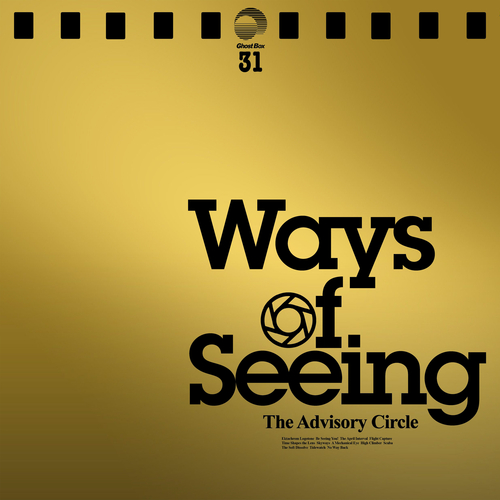
Fairly imminently there will be another fine album by The Advisory Circle - Ways of Seeing, out late May.
Through his own imprintCafe Kaput, Circle chief Jon Brooks also recently put out this album Neil Grant of Lo-Five - whose album When It's Time To Let Gofor Patterned Air Recordings pleasured me last year - has set up a collective of Liverpool-based experimental electronic musicians under the rubric Emotion Wave. Here's Neil's project rationale . Emotional Wave has some musical output already under its collective belt and I believe there is a non-audio entity (printed matter) in the pipeline. And in a week or so Neil releases the Lo-Five miscellany Propagate - remixes, compilation tracks and one-off specials. Neil also alerts me to his having put out a little while back some "super lo fi house tracks" under the title My House Is Your House Volume One. Like Propagate, it's a tide-you-over / palate cleanser type release before the follow-up to When It's Time To Let Go. Love the graphic echo of Human League's "Being Boiled" single sleeve there. (Neil informs me that this was actually unintended - he just got the figures from a Letraset pack! A nice eerie echo nonetheless) ^^^^^^^^^^^^^^^^^ A rather tardy mention of an intriguing my-back-pages project Meadow House by Daniel Wilson of RadionicsRadiorenown. It's really on the very edge of this parish, in so far as it's not particularly haunty, but the back story to Daniel's self-invented Dada-prankster practice of media-dropping - "theact of recording special homemade music and dropping it for random people tofind" - is pretty interesting. ^^^^^^^^^^^^^^^^^ The hypnagogia/memoradelia-tinged project Starbloodhas launched a series based around the concept of late-night TV sign-off themes.
Here's another of their tracks coming more from a dreampop / idyllitronic precinct than this particular parish but nice 'n' woozy nonetheless.
^^^^^^^^^^^^^^^^^^
Parish elders Boards of Canada were recently venerated here and here. ^^^^^^^^^^^^^^^^^^
1 1/ You note that on a personal level you find
something slightly shameful and lame about retro. Perhaps such a reaction
relates to your own obvious fascination and immersion in music. Do you believe
that retro invokes the same emotions in most listeners?
It comes from my own history as a listener – growing up
during the postpunk era, when music was constantly changing and innovation was
the generally held ideal, and then in the 90s being heavily involved in rave culture,
when music was constantly changing and innovation was the generally held ideal.
So those eras have created a benchmark for me of what I think pop
culture should be. And not just those periods alone, but things like hip hop in
the Eighties and much of the Nineties, things like Timbaland and the
future-R&B revolution from the late 90s, and even in the last decade things
like grime and elements within dubstep – they have maintained my belief
in innovation, futurism, a music scene that keeps moving and mutating.
That’s my big buzz. But equally when I listen to music
made before when I first got into it seriously circa 1978, the stuff I most
admire is Sixties psychedelia, Seventies Krautrock, dub reggae, the
arty end of glam like Roxy Music, electric jazz of the Miles Davis
kind... all about pushing the envelope, exploration, strange
hybrids.
At the same time I obviously enjoy quite a bit of
retro-oriented music that’s heavily inspired by the past and plays games with
history. But I tend to believe deep-down that these are lesser pleasures.
They’re not really taking us forward.
2/ Is there much conscious recognition of the
prevalence of retro, particularly among a younger generation for whom recycling
of material is considered standard practice?
I think a lot of them think not only that this is normality,
but that it has always been like this. People who disagree with the book have
said “oh bands have always recycled” . Or even “originality and
innovation” are myths. The point of Retromania is to defamiliarise the musical
present, to show that retro is not the norm historically, but it is an
accumulating cultural syndrome that has built up over the decades until the
current predicament. I’m sowing seeds of discontent and rekindling the hope
that it doesn’t have to be this way.
3/ Is retro not an inevitable consequence of
changes in the way music is listened to. Instead of music that belongs
primarily to a specific teenage generation and which is then jettisoned
it now remains endlessly available within popular culture?
There’s nothing wrong with listening to old music, or even
being influenced by it, but I think it is more productive to use the past as a
springboard to go somewhere new. Too much of the current music scene is either
adding to an established tradition without extending it in any significant way
(Adelle) or it is involved in pastiche and citation and referentiality (most
hipster music today).
4/ Is there a finite number of ways to
express the same emotions, create a functional building or write
a script. Even Shakespeare borrowed his plots after all. Is it possible
that there is very little innovative material left to discover?
Well it is true that a lot of experimental avant-garde music
– and art and literature and film – heads into a zone which is abstract and
anti-emotional. If you have expressive needs, stuff you wish to vent
emotionally, you might well be drawn to established modes of songwriting that
do that job very well. The equivalent of certain kinds of narrative structure
in novels or Hollywood movies. The challenge for pop was to keep
innovating in terms of sound, structure, delivery, lyrics, while still
expressing emotions that are human and possibly eternal. Perhaps the
range in which that can be done has been almost filled up.
5/ You suggest that the download culture has
depreciated the value of music. Is there any way back from this? Can it regain
its original significance for people when so little effort is required to get
it?
I think the problem with the downloading culture is that it
has decommodified music, which sounds very anti-capitalistic and “hooray, we’re
kicking the corporations in the groin”. But it hasn’t returned music to any
kind of “sacred” or communally ritual function that it might have had
before it was commodified as recordings that you bought and used at home
privately. It’s the worst of both worlds: value-less, virtually abject in
its sheer overabundance, something to treat very casually, like water from your
tap. When it was a commodity there was still the possibility of commodity
fetishism, of some kind of desire or mystical investment in the
record-as-object.
6/Is it possible the same fate will befall books?
Possibly, although the sheer length of books and time
required to read them agitates against the kind of senseless downloading and
hoarding that I write about confessionally in Retromania. With books you know
you’ll never get around to reading them, whereas with downloaded music there
seems more likelihood. But certainly with the rise of e-books and reading
tablets, there could be a mass traffic in illegally shared books, which would
be the ruination of publishing.
7/ Has music completely lost its rebellious and/or
political nature? Can you envisage a powerful movement like
punk or the protest songs of the sixties emerging in the modern world?
One thing that fascinated me with the student protests in
the UK in late 2010, and then the street riots in the summer of 2011, and also
with the Occupy movement, is you get journalists writing articles asking “where
are the protest songs? What is the musical soundtrack for this moment?”. Well
perhaps there isn’t going to be one. Maybe music and politics got decoupled at
some point. Certainly it’s hard to imagine what songs could add to the current
moment. Whereas during the Sixties or postpunk or the early days of hip hop,
message songs did seem to have a certain kind of weight and heft.
8/ Finally, having explored the issued in depth, do you fear
for the future of something that you obviously care for deeply. Are there
things coming down the tracks with the power to startle and maybe even shock us
or should we settle for comfortable, recycled entertainment?
I hear a lot of things every year that are really cool and
interesting, and quite a few that are genuinely new and startling. However they
tend to be singular occurrences – artists as opposed to genres, and sometimes
just particular tracks within a record or oevure – and these artists are also
nearly all very marginal in the scheme of things, they operate a long way from
the mainstream. There’s no shortage of talent out there, genius levels have not
gone down... the problem is the process by which these occurrences gather
momentum and become movements, pop cultural events, rifts in History. That used
to work during the Analogue era – what people call the monoculture – but the
nature of digital culture, which its fragmentation and overproduction, seems to
prevent things on the same level as punk or hip hop or rave from
occurring.
A 2013 interview with Andrzej Marzec for Time of Culture that lays out my thoughts on the topic as they had evolved in the years after the book's publication.
·How should we understand the very concept of “retromania”? In which way
retro strategy is different from the traditional use of archive? Every epoch
somehow relates and refers to the past epochs. What is so distinct, peculiar in
this “retromaniac” particular return to the past?
I’m not sure “retromania” is
a concept, really.It’s a word I used a
title for the book -and I settled on it
towards the end of the writing process, after having failed to come up with a
title I preferred! In the end I think it was the right title, though. I see
‘retromania’ not as a concept or a theory but as an open-ended evocative term
for a bunch of phenomena to do with retro, vintage, nostalgia, revivalism,
curatorial aesthetics, commemorative culture, collecting, reissuing, etc .
These phenomena are related and intermeshed but they also have their own
discrete trajectories and specific determinants, and they can each be traced
back in history a good way (in some cases several decades, if not longer). But
the convergence of these tendencies in the first decade of the 21st
Century adds up to a cultural landscape that seems to deserve a term like
“retromania”. It’s a good ambivalent word for the overall mood of the culture.
For a condition that could be seen as a malaise, but also as something
distinctive and defining of our time, with aspects that are exciting and
culturally productive.
“Mania” is suggestive of something out of
control, an addiction or obsession, something on the edge of madness. It
suggests both craziness and a craze (in the sense of fashion or fad).But mania also contains the idea of
excitement and enthusiasm. And that fits because there are aspects of retro
culture that are enjoyable and compelling. Certainly retro’s charms are
something that I’m far from immune to.The book is written from the standpoint of someone who is as prey to
retromaniacal tendencies as anyone.It’s
a self-critique as much as critique of anybody else.
Incidentally I discovered
recently in my files a pieceI wrote in
1990 that was about reissues and retrospection in rock – it was published by
the Guardian newspaper under a different title, but the title I gave it was
“Retromania”. So these interrelated phenomena that I call “retromania”, they
have been building for a while. And in fact they’ve been a concern of mine
almost from the start of my writing (I was doing fanzines from 1984 and writing
for Melody Maker from 1986).But I think
they have built to a new intensity since the rise of broadband internet circa
2000, which enabled forms of sharing, collecting, documentation and archiving
that are like nothing we could have dreamed of before.That has definitely added greatly to the
manic aspect of retromania – the ease of access to the pop cultural past, the
instant-ness and the total recall that’s possible.
But – as you say-- not only
have all previous eras of human civilization had particular modes of relating
to the past, it’s also true that the anxiety about an excess of history and
historical consciousness is not a new thing either. Look at Nietzche’s On the
Use and Abuse of History For Life. Reading that, I was surprised to encounter
so many pre-echoes of my own doubts and disquiets. That was written in 1873!
2.Vocalist of the band "The Blouse" in one of her
songs sings: "I was in the future yesterday, but now I'm in the past and
it keeps taking me back." When we look at contemporary culture, it seems
that any way of thinking about the future is already behind us. We rework and
use the futuristic vision of the past years (60’-80’), but without any hope for
their fulfillment, we don’t want to create our particular versions of future.
Is there really no future in front of us now and the only future we can imagine
is the one that has failed us and never really happened? Does the future remain
in past as a kind of relic?
It does feel like we have
somehow gone past the future, and now confront the coming decades
without any set of mental images about what life will be like.Whereas for most of the 20th
Century, there were all these pictures and notions of what tomorrow’s world
would look, as drastically different from the present.Buildings would get bigger, planes would get
faster, robots would do all the shit jobs. Or think of the electric charge that numerals like "1999" and "2001" seemed to possess. We don't have any such year-dates that shimmer before us with a sense of possibility, strangeness, or even as a benchmark.
This is the shift that
William Gibson and Bruce Sterling have been talking about – the fading away of
the capital ‘F’Future and the onset of
atemporality, as they call it.A generation
that lives in the digital now.
What was once called the
future, and seen as a scenario of promise, or at least of dramatic and
spectacular difference from the present (dystopia), now seems like it might
look more or less the same as the present. Or may even be significantly
worse.On the one hand, technological
advances of certain kinds seem to be proceeding at a good pace (particularly
medical and communications/information tech/personal computing), but in other
areas like architecture, high speed travel, outer space exploration, there
seems to be a standstill.All those
mid-20th Century visions of tomorrow’s world seem corny, yet also
induce a pained wistfulness, because they never transpired. Science fiction
itself has gone out of fashion, and it has been displaced in terms of youth
taste and popular taste by a resurgence of fantasy. Tolkien, not Asimov or
Arthur C. Clarke.
3.It seems that there is something strange with the
category of newness, we still desire novelty, but I think we cannot or do not
want to create it anymore. Do you think that this concept (newness) is still
useful and diagnoses properly phenomena and transformations of contemporary
culture? Can you give some examples of completely new developments and trends
in contemporary music?
As with “the future” or
“futuristic”, the idea of the new lingers, I think, but in a kind of painful
way, it’s not completely buried and forgotten but nor does it work like it used
to.
Some of what “newness”
provided is still provided through the latest increments in digital technology
– new games, new apps, new internet stuff.My son, who is 13, is buzzed up on this and is chasing wanting the
latest thing in terms of games, computers, social media, netstuff. But I don’t
know if the category of the new or of “progress’ in the cultural-artistic-political
senses means anything to him: the idea that things get better. And I know that
the science fiction concept that ruled my teenage years – outer space, the very
idea of the 21st Century—mean nothing to him.
I can’t think of many really
new things in music. Some of the bass sounds in dubstep – the wobble, brostep,
Skrillex end of it – seem pretty extreme, if not completely new then a
development along on an axis of intensification from things being done in the
Nineties. And similarly the use of AutoTune and “vocal science” effect, while
building on Nineties techniques, seems to be a growth area – it seems to be a
way that musicians indicate contemporaneity and “this is now”. You get that
across the board from mainstream pop and rap to underground and experimental
music – an interest in vocal weirdness, the denatured and posthuman voice.
4.Every new beginning is described by the means of the past
at first, with a usage of concepts from the perspective of a bygone era. Just
to mention that when first TV sets appeared, they were calling them radios with
pictures. Do you think that process of describing contemporary culture from the
perspective of the past is somehow similar tointerpreting TV set via radio? Putting it simply: is the present time
secondary and imitative, or is it the beginning of something new, but we cannot
even find the right category to describe this reality?
Well, TV is kind of like
radio with pictures, isn’t it? Most of the things TV did and have continued to
do – dramas, soap opera serials, news programmes, documentaries, music – are
all things radio did, just restricted to the audio dimension.The unique idiomatic things that TV could do
– experimental TV and video in the Seventies, or Eno’s idea of ambient TV that
would be more like a picture on your living room wall that something you’d
watch – these either remained an obscure, minority art-world function, or never
took off at all.
However I do get what you’re
talking about – there is a tendency for critics to appraise the new medium
using the terms and concepts and metrics of value that apply to a previous
medium. So cinema (even now, still -- in mainstream coverage at least) gets
assessed in the terms of literature or theatre – plot, acting,
characterization, dialogue – and not so much in terms of cinematography,
editing, effects (the areas that are proper and unique to the cinematic
medium). Everyone knows who the actors and directors are but only your hardcore
cineaste theorists know who did the cinematography, lighting, costumes,
editing, décor and props, grading, etc.
The same goes for rock
criticism, particularly in its early days, --critics focused on the lyrics or the social meaning, had very little to
say about groove or sound. That partly reflected their background as students
of humanities, usually English Literature or History or Political Science.But it also reflected a culture-lag syndrome
of the kind you’re talking about.
5.What do you think about hipster culture, what does it
mean for you and how does it influence the condition of contemporary culture?
Why does this category function rather as an insult and the object of derision,
in fact no one wants to admit that he/she is a hipster? Does the diving for
remnants in the dumpster of culture is so shameful or the very concept of a
hipster is identified with the lack of any taste and competence?
Hipster, as a phenomenon, is
closely bound up with retro, but it’s not identical with it. Retro and vintage
is one of the ways hipsters express themselves and accumulate their subcultural
capital. But it can also be done through cosmopolitan exoticism – through
knowledge of other cultures, usually non-Western and subaltern cultures. So I
talk about xenomaniaas a parallel phenomenon to retromania. Both retro and
xeno have existed for decades, but again the internet has intensified both
syndromes hugely.You have hipsters who
know about obscure music from the 1960s and 1970s (or increasingly going back
before World War 2 to pre-war gospel and blues). But you also have hipsters –
often the same hipsters – who are chasing strange new rhythms from the ghettoes
of South America or Africa, things they find out about on YouTube. And
sometimes you get retroxeno – which is the quest for super-obscure African
musiconly ever released on cassette in
the 1970s, or Ocora field recordings, or New Wave music from the former Soviet
Union...
The derision aimed at the hipster comes from an
intuition that the process of turning music into semiotic capital, an index of
coolness and superior skills at scavenging and hunting for things no one else
knows about – that this is voiding the music of its value. The hipster modus
operandi is decontextualising the music from the lifeworld where it actually
had meaning and social purpose, and turning it into décor for your lifestyle or
something that is “costuming the ego”.Even when it’s driven by a genuine hunger for “the real”, the
authentic... which is what it seems to be about in a lot of cases –it comes out, unavoidably, as inauthentic.
But there’s hardly any of us
who escape the taint of hipster... it’s more a sliding scale of tourism and
vicariousness.
I sometimes think of myself
as a hipster who isn’t good with clothes or hair...a failed or partial hipster. I can do the
music-taste part of hipsterism easily, not the other bits.But I’m the wrong age group, also. I have too
much mental and emotional baggage from a pre-hipster era.If hipsterism is the voiding of bohemia of
any actual dissident cultural value, then I still mostly belong emotionally to a world
before that happened.
6.Who is a contemporary artist: genius, a curator, a thief,
a plagiarist, a follower, or a consumer? You are interested in the concept of
recreativity, could you tell me something more about this idea? How attitude
towards originality, copying and imitating changes in our times? Are we able
nowadays to steal somebody’s ideas or we just simple recreate them?
Recreativity is a term I
came up with for a whole set of practices to do with remixing, reenactment,
mash ups, parody, and also for the theories that have sprung up to celebrate
these practices and to attack ideas of originality and innovation, along with
the notion of copyright and intellectual property.As with retro, there’s been a boom of these
practices and their attendant theorizations in the last decade, but they also
go back a long way – through appropriation art in the Seventies, back to Pop
Art in the Sixties, all the way to the readymade and collage in the early 20th
Century.Not forgetting postmodernism
which was in large part all about the rejection of the idea of originality and
origins. And just in the context of pop music, there have been debates about
sampling and “plunderphonics” and the remix going back to the early Eighties.
So in an ironic way, these very 21st Century things like Nicolas
Bourriaud’s theories about postproduction art and curatorial aesthetics, or
things like the early 2000s fad for mash ups, they are themselves remixes of
earlier ideasor they are extensions of
earlier practices of remixing and mashing-up.They exemplify and perpetuate the very syndromes they identify and
celebrate .
To me, the ideas seem
exhausted, they feel like the 1980s all over again...and they are used too often to justify work
that is purely a rearrangement of existing elements, with no X Factor of
newness. “The new is always old” has become a cliché and a defeatist
creed.I do not understand why people
seem to find it a liberating concept, or refreshing.It’s stale and old - and depressing!
To say that “all artists
steal” doesn’t help explain how some artists transform what they steal and
actually create the new. Which keeps on happening.
7.Young generations don’t miss the past usually (they don’t
have their own yet), so what is the reason for this overwhelming sense of
nostalgia among youth nowadays? Do you perceive it as a sign of contestation,
dissatisfaction with the present, disappointment with the future, refusal of
its co-creation, anti-capitalist opposition to the production? Or is it simply
an expression of laziness and unwillingness to take a risk? We can tell a lot
about the past, but this is one of the most secure area we can imagine, nothing
there is surprising or unexpected.
I don’t know if it’s
nostalgia as such.Probably there’s
different levels and different motivations .Some young people are fascinated by the past because the archives in
their teeming clutter provide a space for exploration, you can discover things
in the rubbish heap of history through which you’re sifting, and you can
repurpose them. So it’s a form of cultural archaeology that can involve genuine
interest in the past but also can be purely a present-minded, use-oriented
approach – what can I do now with this old synth, this vintage garment, these
bygone style of graphics or typography.
But then for other young people maybe there is actual longing and
yearning directed to these golden ages of music they’ve read about, the
attraction is to music that seemed to be connected to history and to social
energies in a way that few music today is. So that would be a self-defeating
form of nostalgia, because by channeling energy towards music from the past
they are by definition disconnecting themselves from history and from current
social energies.
Of course music from the
past often has intrinsic qualities and value, in the same way that Shakespeare
or Citizen Kane or whatever does.I
don’t have a problem with people listening to classic old music at all, in fact I think
they should. It’s when they try to recreate it or to base an entire revivalist
lifestyle around that... that’s when it gets problematic.
8.Why we cannot forget about what is left? In your book you
seem to claim that we are doomed to the past because of the improvement of
archive technology – collecting data and access to information have never been
so easy. If nostalgia is something authentic indeed or is it only facade or
decoration and only the modern way of expression, rather form than essence?
It is interesting, and
something that I don’t really explore in the book, how the idea of the
generation gap has faded – the rejectionist impulse of youth doesn’t seem to
apply anymore, in the sense of rejecting their parents’s music. Or in the early
hyper-accelerated days of rock, it was rejecting your older brother and
sister’s music. Glam fans seized on glam because they wanted their own thing,
and the hippie / underground music of just a few years earlier belonged to
their older brothers and sisters. Same with punk and New Wave: it created a
dividing line in history. It would be many years before I listened to Led
Zeppelin or Pink Floyd... when I got into music in 1978, you just took it as
read that the Old Wave of rock was utterly irrelevant, discredited, and
actually devoid of any musical value.
12.Would you agree with the statement that titling this book
Retromania you are also as the author filled with nostalgia? You quite
frequently repeat that modern world is no longer the same as before. For
example, today bands refer rather to the entire list of their inspiration
("playing as Joy Division") instead of manifest their differences and
emphasize originality, no one is waiting for a new album as much as it happened
before and so on. Your longing for the past seems to be rather nostalgia for
the past type of albums production (not overproduction), their distribution
(not YouTube) and consumption of music (not iPod or shuffle mode). You write
about music, albums and bands as if they have lost their aura, uniqueness,
inaccessibility and mystery.
I don’t know about that.
Personally, I have all kinds of nostalgia for various periods of my life, and
periods of culture. But I strongly resist this idea that when you talk about a
decline, or a change even, in how culture works, or the nature of music – that
this can be simply dismissed as nostalgia.To point out that things are different in a certain respect, doesn’t
necessarily mean that you want to go back.
An example: after punk and
New Wave, it is simply undeniable that British rock bands, on average, were
less groove-oriented and capable of “feel” than they were in the Sixties and
pre-punk early Seventies. This is because of a number of factors:punk discredited the idea of virtuosity and
paying your dues, so that by the time they were getting make records, New Wave
bands were less seasoned and tight as performing units; New Wave music had
moved away from its grounding in blues and in American musical sources
generally.Now you can say that “feel”
and “groove” are old fashioned values, if you want, or you can say that
postpunk and New Wave made up for that diminishment through other aspects of
the music being radical or exciting or fresh. But just taking that metric of
value, it’s undeniable that the drumming in your average British band
deteriorates from 1977 onwards and it has continued to deteriorate. (Partly I
would say because anyone with a flair for rhythm has been more like to get into
electronic dance music and apply to it drum machines, sample-loops, digital
audio workstation programming etc). To say that this has happened isn’t
nostalgic, it’s pointing to a real and measurable decline along one metric or
axis of judgement.
So in terms of what I’m
writing about in Retromania, I think the book can be seen as in part a neutral
description of changes caused by the transition from an Analogue System to a
Digital System.Parts of the book – the
stuff to do with YouTube and with filesharing and MP3s in particular – are a
kind of phenomenology of digital life, an anatomy of its sensations and
affects. The Analogue System made possible certain kinds of affect and
convergence of energy;these occur much
less frequently or much more weakly in the Digital era, if at all.
But since my expectations of
music was shaped by experiencing those affects and living through such
convergences of energy: postpunk, rave, etc) you could justifiably view
Retromania as a requiem for the Analogue System.There is an element of mourning the passage
of an entire world and the kind of subjectivity shaped by it. The Analogue-era
sense of culture-time as linearity and forward propulsion has been displaced by
atemporality and a recursive, archival logic.So the interest is what new convergences and affects are emerging out of
this altered sense of time and space?How will music function in the new order? So far it’s very unclear--mostly we are still living inside the wreckage of the Analogue
System.Will pop music have the
privileged status it had or has it become just one zone or componenent with the
entertainment landscape? The sense is that the old power and function that
music had has decisively gone but we don’t know yet what powers and functions
it will have.
13.I know that you are planning a new book. What comes after
retro and what will be the subject of your research this time? Will it be
another come back of the past and you will continue threads started in
Retromania or you will focus on completely new territory?
I had so many ideas after Retromania came out, through doing so many
interviews and public appearances, but also just thinking further on the
subject, responding both publicly and mentally - in my own head - to critiques of the book, etc, that I could easily
write another book on the subject. There’s lots of things I should have said,
and I can see ways of making the argument clearer and more far reaching - and inarguable! But I
think it’s time to move on to a new subject.The next book is partly historical and partly about the present: its
main subject is glam rock, but I’m going to be connecting that to contemporary
pop culture and looking at things like stardom - fame as a cultural pathology.
Recently I was in a well-known - indeed "iconic" - record store, where I flicked through an assortment of brand-new and recent releases, checked them out on the decks, and found most of them to be pastiches of earlier styles of music (styles abrasively new and unforehead at the time of their emergence) or solid / stolid, worthy additions to long established and revered traditions. Business as usual, then.
For much of my visit to this store, Manuel Gottsching's E2-E4 burbled blissily in the background. That got me thinking.... Isn't it strange how the Once-Was-New can still sound new, somehow - no matter how long ago its moment was... despite the huge number of times you've been exposed it? The force of its former insurgence rings out, even though its innovations will have been assimilated and endlessly recycled by subsequent artists. * That applies to Madame Bovary as much as to Jimi Hendrix, to the Pastoral Symphony as much as to "Hymnen", to Performance as much as "Terminator" (the track not the film, silly!), to "The Harlequin's Carnival" as much as to McCabe and Mrs Miller...
Everything now classic was once radical: in its own time, a breakthrough or a break-with-tradition. Equally, anything in the present that styles itself as "classic", that defers to a hallowed earlier moment, that adheres to and abides by a Legacy - it will not and cannot be a classic in the future, or for the future. The sieve of time will sift these out. And in the meantime, we really shouldn't bother with them. Not when there's a superfluity of now-classics / then-breakthroughs existing in the world that can renew our inspiration... and strengthen our resolve to never settle for less. * How does this effect of once-new, always new actually work? A snippet from an old blog essay about the modernistic drive of the hardcore nuum, in which I redeploy some nifty thinkage of Frederic Jameson: According to Fredric Jameson, what defines the modernist artwork is a relationship to time. It enacts the break with the past forms of art within itself. "The interiorization of the narrative [of modernity/modernism]…" becomes an integral element of the artwork's fundamental structure. "The act of restructuration is seized and arrested as in some filmic freeze-frame" such that the modernist work "encapsulates and eternalizes the process as a whole." What could that mean in music? Precisely a genre [jungle / drum + bass] that involved a kind of suspended clash of sampling/digital processing with the analogue/hand-played, such that the uncanny time-warping of digital technique coexists with and permeates the hands-on, real-time musicianship. Thus breakbeat science captures the moment of superhumanisation, the funk of flesh-and-blood drumming (just eight seconds of G. Coleman's life-force from "Amen, My Brother") mutating into something beyond itself. Likewise with vocal science. Jameson, again: "the older technique or content must somehow subsist within the work as what is cancelled or overwritten, modified, inverted or negated, in order for us to feel the force, in the present, of what is alleged to have once been an innovation." The shock of the new, eternalized.
A man argues that the year 2000 is now officially retro. It being 17, 18 years ago - which is almost two decades, and 20 Years being the traditional cyclical point at which things get revived or start to seem quaint.
What he (Matt Novak) specifically means, though, is that the year's 2000's ideas of "futuristic" now seem retro-futuristic. (The site he's writing for is Paleofuture, which is all about retrofuture).
I don't remember that much actual futurism or futuristic-ness in 2000. Although it's a year that seems indistinct in my memory... I'd have to strain to actual recall what was big or happening in music, or pop culture that year.
(Strains for a bit)
2step in the UK was still dominating the Top 40 in 2000... the Timbaland R&B wave, although peaked, was still rolling... dancehall... Southern rap in the bounce and crunk style... All of them pretty shiny and modern, yes, but futuristic? I'm not sure. If it was futuristic it was pretty much a continuation of the Nineties vibe of future-now, shiny digital sleekness).
But there was also - in the early 2000s - a lot of actual retro happening in real-time. There was the garage punk revival, the electro / Eighties revival was taking off, there was the early stirrings of the postpunk revival, Even filter-house and Daft Punk had its nostalgic, past-recycling aspect.
So it's not really the case that 2000 that has become retro; it's more that it was the beginning of the retromania era that was the Noughties.